Monday, August 27, 2012

Book Review: Fahrenheit 451 by Ray Bradbury


Fahrenheit 451 
by Ray Bradbury


“We must all be alike. Not everyone born free and equal, as the Constitution says, but everyone made equal. Each man the image of every other; then all are happy, for there are no mountains to make them cower, to judge themselves against. So! A book is a loaded gun in the house next door. Burn it. Take the shot from the weapon.” — Captain Beatty


     Ray Bradbury would have been 92 years old this past Wednesday (August 22, 2012).  He was a prolific writer of science fiction and horror stories, novellas and novels and is best known for Fahrenheit 451, first published in 1953 by Ballantine books.  

   This is the story of Guy Montag, a fireman in a future America.  In this society a fireman's job is not protection from fire, but to burn books and the homes which contain them.  The goal of this is to remove the influence of literature.  Guy begins to doubt his purpose in life when he meets a young neighbor girl named Clarisse.  Clarisse is a romantic and encourages Guy to appreciate and engage his surroundings and life in general:

“You’re not like the others. I’ve seen a few; I know. When I talk, you look at me. When I said something about the moon, you looked at the moon, last night. The others would never do that.”

     Clarisse and her family disappear under suspicious circumstances and Guy ponders the meaning of his discussions with Clarisse.  He becomes frustrated with his wife Mildred who sits all day enveloped in a television "room" where her stories are displayed on the walls.  Mildred talks of the actors as if they were family and her whole life becomes interchangeable with the plots of the television dramas.

     Guy becomes particularly distraught when, during the process of burning a book-filled home, the old woman who owns the home perishes in the fire.  He begins a process of pilfering books and keeping them in his home (well aware of the danger of such action) and befriends an old theologian.  In the final chapters of the book Guy is revealed as a book owner and he is on the run from the authorities after a particularly violent confrontation at his burning home.  In hiding out in the country, Guy encounters other intellectuals on the lam and witnesses the beginning of an Armageddon-like war.  

     There have been many interpretations of this brief but powerful novel.  Many center around the idea of censorship and suppression of knowledge by the state.  Bradbury himself stated that the novel was more about the dehumanizing effect of television on humans - taking over their lives and thoughts at the expense of self-knowledge, free thinking and individuality.  How prescient is this novel, written nearly sixty years ago?  Today we do have room-sized televisions, 3-D screens and surround sound, much like the "television rooms" Bradbury describes in Fahrenheit 451.  We also have the phenomenon of "reality TV" where the characters in these shows become like family for some.  We live in an age where the majority of adults never read a book and what passes for literature is basically trash (Fifty Shades of Grey, anyone?).

     This novel is well worth reading, not only for the critical ideas the author explores, but also for the quality of the writing, so absent from today's "literature."


Thursday, August 16, 2012

Book Review: The Submission by Amy Waldman


The Submission
By Amy Waldman

     Amy Waldman is a journalist (“The New York Times” and “The Atlantic”) and this is her first novel.  The premise of the book alone is pure genius.  As the book opens a non-partisan committee is evaluating over 5,000 designs which have been anonymously submitted in competition for a memorial to be constructed at Ground Zero.  Claire Burwell, the only victim’s family representative on the committee is strongly advocating an intricate garden with a tablet display of names etched in stone. Other committee members, including the governor’s representative and several artists, are advocating for a more traditional style memorial.  The time is about two years after the 9/11 attacks and the United States is actively engaged in the “War on Terror” in Iraq and Afghanistan.  Claire focuses on the garden design because she feels it best represents the ideals of her dead husband and also that it would be the most soothing place for her young son to visit.  After much deliberation, the committee is swayed by Claire and the garden design is chosen.  When the envelope identifying the winning designer is opened, the committee is aghast when it is apparent that the winner is an American born Muslim named Mohammad Kahn. 
    
     The committee searches for a way out of this conundrum.  The Muslim won the competition fair and square, but the anticipated public relations nightmare has to be considered.  The governor, who has national political ambitions, applies great pressure through her representative to squash the winner and move on to another design.   Claire, as well as a majority of the committee members, feels that in the true American spirit Mohammad Kahn should remain the winner.  Before the committee has a chance to solidify its position, the information regarding the winning design and its Muslim designer is leaked to the tabloid press.  “The New York Post” has garish headlines the next morning decrying the committee’s selection. 
       
     The heat rises as victim family groups rally against the design (most specifically against the designer).  Further complications ensue when the press implies that the design is borrowed from a Muslim tradition of paradise gardens, the memorial then actually becoming a symbol of victory for the terrorists rather than a tribute to the fallen Americans.  The furor increases even further as Mo Kahn refuses to withdraw from the competition and also refuses to discuss the inspiration for his design or the implication that it represents the terrorists’ reward.  He does this on the grounds that he would not be asked these questions if he were not in fact a Muslim.   Once it is known that Claire was the main advocate for the garden memorial, victim families turn against her and threats are made.  The situation escalates as the media sensationally fans the flames of fear, prejudice and hatred.
      
     The story reaches a very unexpected climax, centered around one of the secondary characters.  Asma Anwar is an illegal alien from Bangladesh, whose husband was a janitor in one of the World Trade Center towers and was also killed on 9/11.  Asma, a Muslim, becomes the eye of the storm late in the book when she speaks out at a public hearing regarding the design.  She makes an endearing statement regarding the memorial design, noting that this memorial was for her husband and family as well as for the American victims.  When the press probes into her story and it becomes known that she received a seven figure victim family settlement from the United States government, outrage ensues. 
    
      The plot, obviously, is the backbone of this novel.  The premise and resulting roller coaster ride of public opinion, reaction and backlash makes for a riveting read.  The character studies which the author has included should not be over looked, though.  The complexities of Mo Kahn, an American born Muslim who isn’t particularly religious and yet sticks to principles are very compelling.  Claire Burwell is also a living contradiction, fiercely defending her choice of design initially but then bending to the enormous weight of public opinion and backlash and second guessing herself and her motives.   The politicians play the situation for all of the publicity gains that they can, using the situation to further their aspirations.  Asma Anwar actually becomes the most sympathetic character in the whole complicated story; something which I can’t help but think was intended by the author. 
    
      Ms. Waldman has created a novel which may be the novel that in 100 years people read to find out what was going on in the minds of Americans during the aftermath of 9/11, just as we now read Theodore Dreiser, Sinclair Lewis or John Steinbeck to understand what was going on in the minds of Americans in the early 20th Century.   This is an incredibly entertaining read, but, more importantly, causes the reader to be introspective and analyze his or her own emotions, motives, prejudices and preconceived notions regarding the Muslim religion, religion in general, politics and media manipulation of our knowledge and opinion.  I can’t recommend this book highly enough.

Wednesday, August 15, 2012

The Campaign, starring Will Ferrell and Zach Galifianakos


"The Campaign"
Starring Will Ferrell and Zach Galifianakos

     Political satire has existed at least since the time of Aristophanes (446 B.B.) and takes many forms.  Cartoons, novels, newspaper and magazine commentary as well as television and film programming have all been used for this purpose.  In recent decades "Saturday Night Live" has successfully lampooned presidential candidates and other politicians with memorable skits involving Chevy Chase as Gerald Ford, Dana Carvey as George H.W. Bush and Ross Perot and Will Ferrell as George W. Bush, among others.  "The Campaign"  does not target any one particular individual, but instead lambasts the entire political process.   

    This movie is as zany as you might expect from the pairing of Will Ferrell and Zach Galifianakos.  The story line features Ferrell as incumbent Cam Brady, a U.S. Representative from the 14th District of North Carolina.  Cam is the quintessential airhead with "a $900 haircut" who Ferrell portrays as a combination of his George W. Bush impersonation and his Ricky Bobby character from "Talladega Nights."  Brady is running unopposed until his tawdry affair with a model is exposed.  He made the egregious error of placing an obscene phone call to his mistress which unfortunately, thanks to a misdial, ends up on the message machine of an evangelical Christian family.  A pair of unscrupulous businessmen (Dan Akroyd and John Lithgow) want to elect more candidates who will endorse their profitable Chinese manufacturing enterprise and draft Buddy Huggins, the "odd" son of an associate living in North Carolina (Galifianakos) to run against the now seemingly vulnerable Cam Brady.  The campaign quickly spirals down to mud-slinging, name calling exaggerations from both sides.  There are some truly funny moments such as when Brady can't remember the words to the Lord's Prayer during a debate.  Brady then deflects attention from that miscue by accusing Huggins of being a Communist because of his two pug dogs.  ("Those dogs are Chinese, people.  Chinese!").  Brady's tawdry affair is exploited to the max and he also is arrested for driving under the influence.  The movie also successfully lampoons the media and the reliance on polling numbers.  Marty receives a "two point bump in the polls" after he shoots Brady in the leg during a hunting "accident."   Brady's sex tape promotional advertisement "tests well with men."  Predictably, the movie includes a lot of crude humor and foul language.  The movie also drags a bit and seems like a "Saturday Night Live" skit that just goes on too long.  As slap-stick comedy "The Campaign" is successful, but as meaningful political satire it just isn't.  I enjoyed it and would go to see it again.  If you go to see "The Campaign" though, don't expect a comedy classic.

Sunday, August 12, 2012

Chateau Morrisette


Chateau Morrisette
Sunday, August 12, 2012


     Chateau Morrisette is a winery located directly off of the Blue Ridge Parkway near Floyd, Virgnia (south of Roanoke).  They are best known for their "Black Dog" wines and their five star restaurant.  They also host several notable music festivals throughout the summer and fall.  We drover their today because they were featuring food and beer from The Weeping Radish Restaurant and Microbrewery located in Grandy, North Carolina (on the mainland near the Outer Banks).  The Weeping Radish had been one of our favorite places to visit in Maneo, North Carolina during vacations in Nags Head before it closed that location and moved to Grandy.


     The grounds of the Chateau Morrisette are magnificent.  There are pleasant views of the surrounding mountains and their gardens are attractive and very well maintained.  The gift shop is housed in a 33,000 square foot building which I was told is the largest recycled timber building in the United States.  The large beams of the building were salvaged from a warehouse in the Pacific Northwest and the smaller timber came from old ships.  In this building you can tour the winery, buy wine related souvenirs and enjoy a wine tasting.  We were there for the beer, however, so we didn't do any of those.


     There was a fine four piece band named "Bone Cold" which played an energetic mix of 70s and 80s rock and roll.  Their singer was particularly talented.


     The highlight of the day, however, was indeed the brats and beer sold by The Weeping Radish.  We enjoyed   a few beers and had lunch, listened to the band and bought some wine.  The weather was absolutely perfect and we enjoyed the drive home along the Blue Ridge Parkway.  I'm sure we will return soon and often to Chateau Morrisette and next time I want to take the wine tour and enjoy the restaurant.


Wednesday, August 8, 2012

Book Review: The Great Influenza by John M. Barry


The Great Influenza
By John M. Barry

(Blogger Note: This review was previously published in "LAMLight," the physician newsletter of the Lynchburg Academy of Medicine.)
  
The 1918 influenza pandemic which began in Kansas and killed an estimated 100 million people world-wide in a 24 day period is examined in great detail in The Great Influenza by John M. Barry.  Although this is an extensively researched book with a tremendous amount of medical and scientific information it is never boring.  This is a story which could have been as sleep-inducing as an M-1 Histology lecture but has the pace of a Grisham novel and the suspense of any best-selling mystery.  In the Prologue Mr. Barry describes his book as “a story of science, of discovery, of how one thinks, and of how one changes the way one thinks.”  The lessons learned in the early 1900s are very appropriate to be reviewed a century later. 

The story is divided into ten sections.  The first “The Warriors” is an overview of American medicine as it existed in the late 1800s and how it was revolutionized mainly by William Henry Welch and the Johns Hopkins Medical School and research laboratories.  Dr. Welch almost single handedly changed American medicine from a field not far removed from the practices of Hippocrates to a rigorous, science based investigative discipline.  Welch, along with William Halsted at Hopkins and Simon Flexner of the Rockefeller Institute brought American medicine into the modern age and enabled the medical response to the 1918 Influenza epidemic.

The following sections “set the stage”.  Section two (“The Swarm”) is a very succinct course on virology, directed to the layman and appreciated by this reviewer who is very deficient in his knowledge of infectious disease.  “The Tinderbox” explains the social and geopolitical factors which contributed to the situation which became the perfect storm for a pandemic.  The U.S entrance into the Great War precipitated a number of amazing circumstances.  For those appalled by the the George W. Bush administration's Patriot Act and its potential for restriction of personal freedoms, Woodrow Wilson’s Sedition Act looks like downright fascism.  The Sedition Act was responsible for the imprisonment of anyone who spoke or published words questioning the federal government.  This Act was eventually upheld as constitutional by none other than Chief Justice Oliver Wendell Holmes.  This law essentially put a lid on any accurate reporting of the flu epidemic.  The facts were thought to be detrimental to public morale and the war effort.   The conscription of most men between 18 and 45 years of age created crowded conditions in training camps, again creating a situation ripe for rapid dissemination of infectious disease.  Physicians were secretly “graded” by local medical societies and the best physicians and almost all nurses were rapidly conscripted into the army and sent over seas, leaving the medical care of the citizenry to older physicians, trained prior to the era of scientific method and regarded as “inferior”.  The Rockefeller Institute was transformed into “Army Auxiliary Laboratory Number One” and entire medical school faculties were sent as units to Europe.

The ensuing sections of the book documents the incredible spread of the disease and the terrible ferocity with which it struck, especially in younger patients.  At one point at Camp Pike in Arkansas, for instance, 13,000 out of 60,000 soldiers were simultaneously sick with influenza.  The death rate among young adults approached 40% and often people woke up feeling fine, had an acute onset of symptoms and were dead within twelve hours.

The modern laboratories established by Welch at Hopkins, Victor Vaughan at Michigan, Charles Eliot at Harvard and William Pepper at Penn as well as Oswald Avery at the Rockefeller Institute, William Park and Anna Williams (virus experts) at the New York City Department of Public Health and Paul Lewis in Philadelphia were all in a race to identify the pathogen responsible for this pandemic and, if possible, develop a vaccine to treat and prevent the disease.  The desperation caused by the presence of death all around them, including within the ranks of their own laboratory workers produced a frenetic research response.  The work produced in 1918 is still evident today.  Pfeiffer discovered the “Influenza Bacillus” (what we call H. Influenza today) which was the bacteria responsible for the rapid demise of the younger patient population.  Avery developed the “chocolate agar” growth medium to expedite growth and identification of H. Influenza, which clarified the role of this pathogen in the pandemic.  Many of the deaths were in fact due to secondary overwhelming bacterial pneumonias and what we recognize today as acute respiratory distress syndrome. 

The concluding sections of the book deal with the aftermath of the pandemic.  The repercussions were felt in every segment of society and in every geographic location.  An interesting historical footnote is that Woodrow Wilson succumbed to influenza during the negotiations at the end of World War I.  After two week convalescence, Wilson backed off of all of his previous demands, conceded to the French and stripped Germany of territory, its army, and crippled its economy.  The author hypothesizes that Wilson was suffering from post-influenza psychosis or mental disturbance and quotes Lloyd George as saying “Wilson suffered a nervous and spiritual breakdown in the middle of the Conference (the Paris Peace Commission).”   Barry concludes: “Historians with virtual unanimity agree that the harshness toward Germany of the Paris peace treaty helped create the economic hardship, nationalistic reaction, and political chaos that fostered the rise of Adolf Hitler.”

The flurry of research activity during and following the pandemic led to the discovery by Avery that the substance that transformed a pneumococcus from one without a capsule to a more virulent one with a capsule was DNA.  A report from Avery, MacLeod and McCarty titled “Studies on the Chemical Nature of the Substance Inducing Transformation of Pnuemococcal Types.  Induction of Transformation by a Desoxyribonucleic Acid Fraction Isolated from Pneumococcus Type III” was published in the February 1944 Journal of Experimental Medicine.  This report demonstrated that DNA carried genetic information, that genes lay within DNA.  This report was the direct result of Avery’s years of research into the cause of the 1918 influenza pandemic.  This information inspired many scientists, including James Watson and Francis Crick to determine the structure of DNA.  Watson wrote in The Double Helix:  "Avery gave us the first text of a new language; or rather he showed us where to look for it.  I resolved to search for this text.”  Barry observes: “In fact, what Avery accomplished was a classic of basic science.  He started his search looking for a cure for pneumonia and ended up opening the field of Molecular Biology.”

The author concludes by warning that although medical science has made incredible strides, the stage could be set for another pandemic.  Overcrowding in urban areas, poor hygiene and sanitary conditions in third world countries (as well as American inner cities) and the “shrinking of the planet” by international travel all contribute to a situation where a virulent new virus, should it occur, could spread rapidly.  The severity of a pandemic similar to “The Great Influenza” would easily and quickly overwhelm the world’s medical system.  The World Health Organization has guidelines in place to accurately assess risk of new diseases and promptly respond to that risk.  These lessons learned from the 1918 experience are largely responsible for the quick identification and limitation of SARS (Severe Acute Respiratory Syndrome, a disease which spread from animals to man in the spring of 2003).  Barry warns, however, that “Every expert on influenza agrees that the ability of the influenza virus to re-assort genes means that another pandemic not only can happen, it almost certainly will happen.”

The Great Influenza by John M. Barry is an excellent book and a tremendous compilation of data and information on this timely subject.  

Tuesday, July 31, 2012

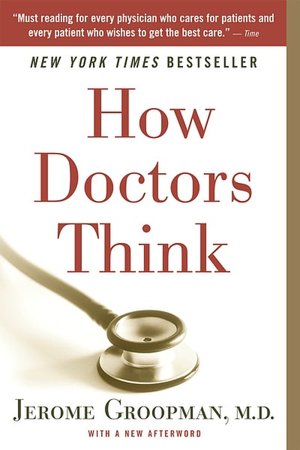
Book Review: How Doctors Think by Jerome Groopman


How Doctors Think
By Jerome Groopman

“Different doctors have different styles of practice, different approaches to problems.  But all of us are susceptible to the same mistakes in thinking.” 
              -  From How Doctors Think  by Dr. Jerome Groopman.
  

Dr. Jerome Groopman is an oncologist/hematologist and chief of experimental medicine at Beth Israel Deaconess Medical Center in Boston.  He has written several previous books and many magazine articles on medicine and biology.  These have appeared in “The Boston Globe Sunday Magazine”, “The New Yorker” and “The New Republic”, among others.  My opinion is that How Doctors Think, his latest book, should be required reading for every medical student, intern, resident and practicing physician.  It wouldn't be a bad idea for patients who wish to better understand their medical care and insure that they are being treated for the proper diagnosis to read this as well. 

The author notes the growing public demand for “quality of care” and reduction of medical error, citing recent reports from The Institute of Medicine and the National Patient Safety Foundation.  He notes, however, that medical error differs from misdiagnosis.  “It (misdiagnosis) is a window into the medical mind.  It reveals why doctors fail to question their assumptions, why their thinking is sometimes closed or skewed, why they overlook the gaps in their knowledge.  Experts studying misguided care have recently concluded that the majority of errors are due to flaws in physician thinking, not technical mistakes.  As many as 15 percent of all diagnoses are inaccurate, according to a 1995 report which matches classical research, based on autopsies, which shows that 10 to 15 percent of all diagnoses are wrong.”

What are the flaws in thinking that lead to these misdiagnoses?  Dr. Groopman, referencing experts in cognitive theory and psychology, discusses three main categories of flawed thinking.  The first is termed “anchoring”.  This is when the physician grabs on to the first symptoms discussed by the patient and comes to a snap judgment.  The classic example of this is the overweight patient who complains of heartburn and is diagnosed with esophageal reflux when he actually is having angina.  The second flaw derives from the first and is termed “attribution error” which is a sequence of diagnosis and treatment begun with anchoring and continuing because of the doctor’s stereotyping of the patient.  Again, the physician has formed a quick first impression and doesn’t deviate from that assumption.  The third and final flaw is called “availability error,” that is, when thinking is clouded by recent experience.  In this example, the last thirty patients with this symptom have had reflux disease, so that must be what this patient has as well. He illustrates each of these cognitive errors with very compelling true life case histories, many from his area of expertise, oncology. 

            Dr. Groopman also has unkind things to say about how physicians are taught to diagnose and treat.  He dislikes diagnosis decision trees and treatment algorithms, feeling they limit thinking and promote another form of error which is termed confirmation bias.  In this setting the physician makes the data he obtains “fit” the algorithm which often leads to misdiagnosis and failed treatment.   The author is also not a fan of evidence based medicine, feeling that it relies too much on numbers which may be generated by flawed or limited technology.  He also feels that strict use of evidence based medicine leaves no room for intuition, “hunches” or thinking outside of the algorithm.

            The author also warns against what he terms “diagnosis momentum”.  This situation occurs when a patient is given a diagnosis by a specialist or academician and that diagnosis is never called into question by other physicians.  The correctness of this diagnosis is never challenged, even if subsequent data may contradict it.

            In the most important chapter in this book Dr. Groopman decries the lack of history taking skills in modern physicians.  He quotes William Osler: “If you listen to the patient, he is telling you the diagnosis.”  One study is cited where the average time from the first open ended question from the doctor to the time of the first interruption by the doctor was 18 seconds.  “Technology has taken us away from the patient’s story” decries Dr. Groopman.  Further: “Competency is not separable from communication skills.  The art of medicine is the sensitivity to language and emotion that makes for a superior clinician.”  Profound words, those.

            Dr. Groopman suggests three questions which patients should ask their doctors when they feel they are not responding to treatment.  These are:

   1- “What else can it be?”   This question should prompt the doctor to pause, think again, and extricate himself from a cognitive trap
   2- “Could two things be going on to explain my problem?” This addresses the pitfall of “satisfaction of search”, so if the physician stopped looking after finding an initial abnormality (Ockham’s Razor), he or she will now consider multiple causes for persistent symptoms.
   3- “Is there anything in my history, physical examination or lab tests that seems to be at odds with the working diagnosis?” This question is an important safeguard against confirmation bias (making the data fit the diagnosis).

All of these seem to be reasonable questions a patient can use to refocus their diagnostic and treatment process when things are not going well.

            I have only two complaints about this book.  The first is that the author only spends one paragraph describing “defensive medicine” and the impact of litigation on decision making.  There is no denying the reality that the shadow of malpractice litigation falls on every medical decision made and I think the author underplays it.  The second complaint that I have is that he glosses over the business side of medicine.  He does spend some time describing economic pressures which have dramatically increased the number of patients physicians must see daily just to remain economically viable.  This obviously decreases the amount of time spent with each patient and increases the likelihood of cognitive as well as other errors.  He never really delves into the cost of following “hunches” or thinking outside of the algorithm.  The cost of searching for obscure or unlikely diagnoses is never really brought into the argument. 

            This book has already changed the way I practice.  I find myself reviewing lab and radiology data looking for inconsistencies with my diagnoses.  I am wary of “diagnosis momentum” and find myself asking a long-time patient the question “Let’s start over and tell me how all of this started again?”  I try not to stereotype patients and try to look past “non-compliance” as a diagnosis and try to find out why a patient is non-compliant with their treatment regimen.  I try to let a patient talk for more than 18 seconds.  Read this book, you’ll be glad you did.

Wednesday, July 18, 2012

Book Review: The Drop by Michael Connelly


The Drop
Michael Connelly


     Michael Connelly is a former “Los Angeles Times” crime reporter who writes first rate mysteries, most of which are set in Southern California.  He is very prolific, having written several stand-alone novels (Bloodwork, Chasing the Dime, The Poet), five more books in a series featuring an eccentric defense lawyer named Mickey Haller (starting with The Lincoln Lawyer) and seventeen novels in a series featuring LAPD detective Harry Bosch.  The Drop is the latest in the Bosch series. 
 
      This novel will not disappoint Connelly fans as it feature two intricate plots, takes us further into the self-righteous mind of Detective Bosch and exposes more of the intricacies of big city politics.  Bosch is facing several personal dilemmas.  First he is adapting to the role of single father.  His fifteen year old daughter Maddie is now living with him and this adds another layer of responsibility to his already crowded plate.  Series readers will know why Maddie is now living with Harry having read the 15th book in the series, 2009’s Nine Dragons.  Harry is also facing the DROP, a police acronym for a delayed retirement option plan.  His time on the force is limited and he wants to catch as many bad guys as he can before he is put out to pasture.
   
     Harry is working with a new partner, an Asian-American named David Chu.  Harry Bosch is notoriously difficult on new partners, preferring to work solo and having had many partners shot over the years.  They are investigators in the Cold Case Unit and receive a new case prompted by a DNA match.  Blood found on the neck of a rape and murder victim from 1989 was run through the DNA data bank and a match is found with a convicted child molester and sex offender.  The problem is that the person so identified is only 29 years old which would have made him eight at the time of the crime.  Bosch and Chu must investigate to discover whether this person was indeed involved in the crime at such a young age or whether there was a mix-up in the crime lab. 
   
     On the same day that they receive the cold case investigation, a presumed suicide victim is found at the Chateau Marmont, a glamorous Hollywood hotel notoriously known as the site of comedian John Belushi’s death.  The victim is an attorney and son of a city councilman.  The councilman, Irving Irvin (again, familiar to long-time readers from previous Bosch books) is a former policeman who requests that Bosch head the investigation into his son’s death.  Bosch and Irvin go way back and their relationship has been adversarial at best.  Bosch is more than a bit perplexed as to why Irving asked for him to lead the official investigation into his son’s death.
   
     What follows is an intricate police procedural as Chu and Bosch chase down leads on both cases.  The cases remain completely distinct from each other and both investigations have false starts and red herrings.  The resolutions to both cases vex Detective Bosch, one because he fails to avert a disaster he should have seen coming and the second because he realizes he was used as a pawn in what he terms “high jingo”, or backstabbing high level city politics.
  
      Michael Connelly again displays his encyclopedic knowledge of Los Angeles:  its history, geography and sociology.  His settings and descriptions are intricately authentic and add a tremendous amount of realism to this novel as well as all of his previous ones.
   
     This is a great summer and beach book and keeps the reader entertained.  Despite having two distinctly different plot lines going at the same time, the author manages to balance them both and, if anything, the two plots makes the book move along at a very rapid pace.  You don’t have to be familiar with previous Connelly works to enjoy The Drop, but familiarity with Bosch and his previous exploits makes the story much more interesting.  Those of us who have “known” Bosch since he was a young Viet Nam war veteran starting on the LAPD (The Black Echo) it is interesting to see him age and adapt to the new technologies and investigative techniques.  Harry is older, wiser and even more cynical as the years go by, but he still works with uncompromising diligence and integrity on every case, including both of these.  It is interesting to see him parent his daughter Maddie.  Harry is at once overly protective and predictably indulgent.   In The Drop she declares her interest in becoming a police officer.  Bosch has trains her in marksmanship and Maddie is already very competent in regional shooting competitions.  Could this be where the series is heading?  I can’t wait to find out.