Showing posts with label Historical Fiction. Show all posts

Monday, March 28, 2022

2022 Edgar Nominee Five Decembers by James Kestrel


Five Decembers

Author: James Kestrel

Publisher: Titan

Date of Publication: October 26, 2021

Pages: 428


     The five nominees for the 2022 Edgar Award for Best Mystery Novel are: Razorblade Tears by S.A. CosbyThe Venice Sketchbook by Rhys Bowen, Five Decembers by James Kestrel, How Lucky by Will Leitch, and No One Will Miss Her by Kat Rosenfield.  This is the fourth of my reviews for this list of books.  Click on the hyperlinks above to view the previous reviews.  

     This book is terrific.  It combines a fine noir murder mystery, a love story, and a well-researched historical narrative.  The settings of Pearl Harbor, Honolulu, Manila, Hong Kong, and Tokyo are essential to the story and are brilliantly rendered.  The plot is complex but keeps the reader locked in.  The story starts in Honolulu in early December, 1941.  A young couple is found in an isolated shed brutally murdered.  The young woman is Japanese and the young man is a nephew of the Admiral in command of Pearl Harbor.  Detective Joe McGrady of the Honolulu Police Department is the lead investigator and follows the primary suspect across the Pacific to Manila and Hong Kong.  Before he can make an arrest, Joe is captured by the Japanese and spends the rest of the war in Tokyo.  After the armistice is signed on the U.S.S. Missouri, Joe returns to Honolulu and attempts to resurrect what is now a cold case.  Stephen King calls this "An electrifying read.  The last chapter is a real stunner."  These are, believe it or not, gross understatements.  

   I enjoyed this book for many reasons.  The large cast of characters are all well developed.  Joe McGrady is a classic 1940s gumshoe who is very sympathetic and mostly plays by the rules until he doesn't.  Gloves come off when Joe returns to Honolulu in 1945 and realizes he has been betrayed by former colleagues and things aren't what they seemed in 1941.  The plot moves along with many twists and turns.  The settings as I mentioned above, are great.  This author has done an amazing amount of research to bring these locales to life.  The descriptions of the fire bombing of Tokyo and the aftermath of the atomic bombing of Hiroshima and Nagasaki are worth reading the whole book for.   This is a very worthy nominee for the 2022 Edgar Award.   


Saturday, August 21, 2021

Book Review: The Only Woman in the Room by Marie Benedict


The Only Woman in the Room

Author: Marie Benedict

Publisher: Sourcebooks

Date of Publication: August 6, 2019

Pages: 336

    The Only Woman in the Room is the fictionalized story of actress and inventor Hedy Lamarr.  She was a woman famous for her beauty, but a smart, savvy, and independent woman existed behind the glamour.  She was born Hedwig Eva Maria Kiesler in Austria, an only child in a Jewish family.  This book begins with her courtship by Friedrich Mandt, an older arms manufacturer.  He was enamored with her beauty and became obsessed.  She was encouraged in this relationship by her father, who thought that Mandt's connections would protect the Kiesler family from the Germans should they invade Austria.  One condition of their marriage was that Hedy would have to abandon her acting career. After their honeymoon in Italy, the couple hosts many extravagant dinners and parties to enhance Friedrich's munitions business.  Hedy becomes a trusted advisor to her husband and is often the only woman in the room during negotiations and other business meetings.  She pays attention during these discussions and learns about the munitions business and about difficulties the Germans were having with guidance systems for torpedoes.  

     The relationship deteriorates as Friedrich becomes more controlling, abusive, and manipulative.  She decides to escape and devises a clever plan. In London Hedy meets Louis B. Mayer, head of MGM studios in Hollywood and captivates him with her beauty.  She moves to America, negotiates a lucrative contract with MGM, and soon is cast in many blockbuster movies with the most popular leading men of the day.  During this time, she revisits the torpedo guidance system issue and with the help of a famous composer devises a method of alternating frequencies to improve accuracy and prevent jamming of torpedo guidance systems.  She presents her invention in Washington, D.C. to the Navy and, again, she is the only woman in the room.  The idea is rejected, mainly because of her gender.  She did receive a patent and her innovation was implemented in 1957.  This technology is still used today in Bluetooth and wireless devices.  

    The Only Woman in the Room does an excellent job of bringing this fascinating person to life.  Hedy Lamarr's perseverance, determination, and brilliance are a revelation to those of us who only knew her superficially as a Hollywood starlet.  The story is told in the first person from Hedy's point of view which allows for even greater insight into the character, her thought processes, and her motivations.  The author did extensive research to give this work of fiction great credibility.  My only criticism is that the The Only Woman in the Room ends in the 1940s, but the Hedy Lamarr story had many more chapters!  She lived until the year 2000, and died at the age of 85.  The somewhat abrupt conclusion to this book made me want to learn more about this fascinating lady.  There is a documentary which was released in 2017 which gives a more thorough view of Ms. Lamarr's entire life.  Entitled "Bombshell: The Hedy Lamarr Story", the documentary contains many movie clips and interviews with Ms. Lamarr as well as with members of her family.  The author's stated purpose for this book (as well as for her many other books) is to illuminate the significant contributions of many women which have been ignored or overlooked.  In this regard, Marie Benedict has powerfully succeeded!


Monday, January 21, 2019

Book Review: Murder as a Fine Art by David Morrell


Murder As A Fine Art

Author: David Morrell
Publisher: Little, Brown and Company
Date of Publication: May 7, 2013
Pages: 358


     David Morrell has written a fantastic historical novel set in London in 1854.  The two main characters are Thomas and Emily De Quincey.  Thomas was a famous essayist, best known for his 1822 publication "Confessions of an English Opium Eater".  Emily was Thomas' youngest and only surviving child who helped care for the "Opium Eater" in his later years.  Although born into an aristocratic family, Thomas was never adept at finances and spent his younger years living on the streets of London.  In his later years, Thomas was almost always in steep debt, frequently running and hiding from creditors.  Emily was quite the non-comformist, refusing to wear the prescribed corsets and hoop skirts of the day in favor of more comfortable (and risque) "bloomers".  In a later and even more controversial essay,  "On Murder Considered as One of the Fine Arts", De Quincey wrote a detailed account of the factual Ratcliffe Highway murders which terrorized London in the early 1800s.  This essay as well as other of De Quincey's writings have been said to have had a profound influence on Edgar Allan Poe as well as British writers such as George Orwell.  With this historical background, let's talk about this book!

     De Quincey and his daughter are invited to London, ostensibly to promote a new collection of essays.  Shortly after their return, a vicious multiple homicide occurs near the scene of the now decades old Ratcliffe Highway murders.  The circumstances and details are almost identical to the original crime.  Enter Detective Sean Ryan of Scotland Yard aided by a young, ambitious Constable Becker.  They become acutely aware of De Quincey's familiarity with the case.  Lacking a credible alibi Thomas De Quincey becomes Suspect #1.

     The plot leads the police as well as "the Opium Eater" and his daughter through all of London.  The city is described in graphic detail, including the homeless and destitute living on the streets and under bridges and the coal dust which covers the entire city including the more prestigious neighborhoods.  Like the more contemporary novel The Word is Murder by Anthony Horowitz, the city of London itself becomes a major part of the novel.  It was fun to read these books back to back (especially just after a trip to London) as it describes many of the same areas nearly a century and a half apart!

     The minor characters are all well developed as well, especially Emily De Quincey and the young Irish detective Sean Ryan.  There seems to be a real chemistry between the two which never really goes anywhere.  Maybe this will progress in the two sequels, Inspector of the Dead and Ruler of the Night.  

     A note of caution to the faint of heart: the violent scenes in this novel are very graphic and disturbing.  No details are left to the imagination!
Detective Inspector Sean Ryan and constable Becker

     Murder as a Fine Art is a well plotted, fast moving and entertaining mystery novel with excellent writing and engaging characters.  It was a fantastic series debut and I can't wait to read the next two installments!


Thomas De Quincey

Tuesday, January 2, 2018

Book Review: Dreamers of the Day by Mary Doria Russell


Dreamers of the Day

Author: Mary Doria Russell
Publisher: Random House Publishing Group
Date of Publication: December 16, 2008
Pages: 288

     If you are not familiar with Mary Doria Russell, she is a very versatile author who has published science fiction, westerns and historical fiction.  All of her books are well written and are character driven.  She is also very entertaining to follow on Facebook.  Dreamers of the Day was published in 2008 and is a historical novel set in the early 20th century.  

     The main character is Agnes Shanklin, a spinster who lives in Cleveland, Ohio.  The first section of the book describes her early life with a domineering, belittling mother and her family's battle with the Great Influenza of 1918.  Agnes is her family's sole survivor.  In the final two thirds of the book Agnes takes control of her life, decides to travel and arrives in Egypt during the Cairo conference in 1921. There she is caught up in a fantastic cast of historical characters including T. E. Lawrence, Winston Churchill, his wife Clementine and Lady Gertrude Bell.  Agnes finds herself embroiled in conversations regarding rule of the Middle East following World War I.  Arab self-rule comes in conflict with British, French, Jewish, Palestinian and German interests in the area.   The Cairo Conference of 1921 was held from March 12-30 and was convened by the British to sort out conflicting policies regarding the Middle East.  The outcome of this conference defined British and French jurisdictions and created the country of Iraq.  It has been said that you cannot understand the modern conflict in the Middle East without first understanding the politics and the aftermath of World War I and this book helps shed light on that subject.  

     An amusing secondary "character" is Agnes' noisy and fussy pet daschund Rosie.  Agnes goes everywhere with Rosie, including the Middle East.  The problems of traveling with this dog not only allows Agnes to meet some of the famous characters but provides several comic episodes as well.  Agnes and Rosie's excursion on the Nile in a fishing boat is a highlight of the entire book.

     Another hallmark of this author's books is her incredible attention to detail, a result of tireless research.  She has obviously done her homework here, presenting a mesmerizing tour of many famous sites, including the pyramids of Gaza and the Via Dolorosa in Jerusalem.  Agnes becomes very perplexed by the commercialism and crowded, tourist trap nature of the holy sites in Jerusalem (and this was in 1921!).  This is part of her description of visiting the Holy Sepulchre:

"The farther into the shrine we moved, the staler the air became.  Around the periphery of the shrine, the morning processions were assembling, and at least two kinds of incense began to waft toward us.  The cloying scents mixed with the sort of crowd odor that silently proclaims a variable devotion to the principles of good hygiene.  Arab workmen were taking a break from their morning's task, smoking hashish near a side altar.  Eating and joking, they contributed woozy laughter to echoing wails, a rumble of muttered commentary, and the occasional shocking guffaw.  Chants, chimes, and clanking metal chains added to a growing cacophony.  Prayers and conversations grew louder in response."

     Dreamers of the Day was entertaining and educational at the same time.  I enjoyed it quite a bit and would recommend it (and any other of this author's books) highly.


Sunday, July 13, 2014

Book Review: The Book Thief by Markus Zusak


The Book Thief
Author: Markus Zusak
Publisher: Random House
Date of Publication: September 11, 2007
Pages: 235 (Nook Edition) 


     I resisted reading this book because I thought that there couldn't be any World War II/Nazi Germany/Holocaust stories which haven't been told.  I was very wrong.  The Book Thief tells the story of Liesel Meminger, a pre-teen living with foster parents in Nazi Germany.  The effect that this war has on this young lady, her foster family and her neighbors is excruciating.  Portraying Germans as victims is not common but certainly here the characters are indeed sucked into a vortex which they don't understand and aren't complicit with.  Acts of defiance occur despite the risk of dire consequence.  They are swallowed by the machine of war.

     The book is told by an omniscient narrator who is Death himself.  This allows the reader to be present on battlefields, in concentration camps and in Liesel Meminger's town of Molching which is caught in the cross-fire of a hellish war.  The characters are extremely strong, most notably Liesel and her foster father Hans Hubermann.  The pair work together to educate Liesel and she grows in appreciation of the power of the written as well as the spoken word.  Liesel's books, purloined from multiple sources, are her only solace.  Words and books take on even more significance when the Hubermanns elect to hide Max Vandenburg, a Jew, in their basement.  Words and books become the bond of friendship for Liesel and Max.  Words eventually even become sources of solace as Liesel reads to her neighbors in bomb shelters during air raids.

     This is a powerful book which deserves its accolades and status as a long-running New York Times bestseller.  It is a potent statement regarding the effects of war on average citizens, particularly children.  I am very glad that I read it and look forward to seeing the recent movie adaptation.   

Wednesday, February 20, 2013

Book Review: The Known World by Edward P. Jones


The Known World

 Author: Edward P. Jones
Publisher: HaperCollins Publishers
Publication Date: May 25, 2004
Pages: 432 (Trade Paperback Edition)

(Note: This review was previously published in the LamLight, the physician newsletter of The Lynchburg Academy of Medicine in Lynchburg, Virginia) 


     In an 1856 letter to his wife, Robert E. Lee called slavery “a moral and political evil”[1].  Slavery as an institution has existed as long as civilization, and Europeans began taking Africans from their homeland for use as servants as early as the 14th century.  French and Spanish explorers brought their slaves with them on various New World expeditions and the first Africans were brought to Virginia aboard a Dutch ship in 1619[2].  One of the more curious aspects about slavery in the South is the ownership of African slaves by freed blacks.  In his book “Black Confederates and Afro-Yankees in Civil War Virginia”[3], Ervin L. Jordan Jr. writes that, as the American Civil War approached: "Free Afro-Virginians were a nascent black middle class under siege, but several acquired property before and during the war. Approximately 169 free blacks owned 145,976 acres in the counties of Amelia, Amherst, Isle of Wight, Nansemond, Prince William and Surry, averaging 870 acres each.”  Many, it seems, also owned other Afro-Virginians.  The Known World by Edward P. Jones superbly explores this circumstance.

     First, this is an exquisitely crafted story, earning Mr. Jones the 2004 Pulitzer Prize for Fiction and the National Book Critics Circle Award.  Jonathon Yardley, the Washington Post book critic, called this “the best new work of American fiction to cross my desk in years.”  The Atlanta Journal-Constitution states that “It belongs on the shelf with other classics of slavery like Toni Morrison’s Beloved and William Styron’s Confessions of Nat Turner.”  This book really is that good.  It is compulsively readable, captivating and thought provoking.  The format reminded me somewhat of Charles Frazier’s Cold Mountain.  That is, the book is divided into relatively long chapters, each of which can stand alone like a long short story or novella.  Each chapter moves the overall story along, however.

     This is the story of Henry Townsend.  Henry is born into slavery on a plantation in fictional Manchester County, Virginia.  He is trained as a cobbler and soon is renowned for his expertise.  It is noted that even people from Lynchburg considered Henry to be among the best boot makers in Virginia.  There are other references to our area as well, which is another appeal of the book.   Henry is allowed to keep some of the proceeds from his work and saves enough to purchase his own freedom.  Henry eventually purchases land and, finally, slaves.  His land becomes very productive and his “legacy,” as he calls it, grows.  The cast of other main characters includes Henry’s wife Caldonia, his former owner William Robbins, the local sheriff James Skiffington and his Pennsylvania-born wife, Skiffington’s deputies or slave patrollers, Henry’s overseer Moses and a multitude of other unforgettable slaves.  There are “stories within the story” that are wonderful.  One of the most memorable occurs early in the book.  James Skiffington is to be married to Winifred Patterson, born in Pennsylvania and schooled at The Philadelphia School for Girls.  Her discomfort with the institution of slavery is magnified when North Carolina relatives of her husband-to-be give her a young female slave as a wedding present.  Another story involves a slave cook in Arlington baking ground glass into the deserts for her masters.  The plot turns when Henry unexpectedly dies of a fever and Caldonia must carry on the affairs of the farm which become increasingly problematic.   Some of the slaves escape and there is growing competition and unrest among those remaining on the Townsend farm.  The book ends in the post-Civil War era with a reunion of sorts of ex-slaves from the Townsend plantation in Washington, D.C.  There is some resolution of the pre-war tensions and some satisfaction in the success of these survivors.    

     The magic in The Known World, however, is in the author’s ability to the convey emotions and perceptions of his characters.   The gut-wrenching despair of being a human owned by another human is certainly conveyed here, but not as the dominant theme.  The confusion and anxiety felt by the slaves as well as the owners in this “blacks owning blacks” scenario is also a major undercurrent.  There is certainly a sense of loss portrayed here as well, in terms of lost potential contributions by these servants forced into manual labor and menial tasks. The over-riding sentiment here is that the warped and morally abominable practice of slavery created a hugely dysfunctional society that affected whites as well as blacks and owners as well as slaves.  The ramifications of that dysfunction are still being felt today, almost one hundred and fifty years later. This is a fascinating work of historical fiction which sheds light on to the culture and life in Virginia in the 1850s as well as offering a unique insight into the practice of slavery.


[1] Grooms, Robert M., “Black Slave Owners”, the Barnes Review, 1997.
[2] Wahl, Jenny B., “Slavery in the United States”, EH.Net Encyclopedia, 2005.
[3] Jordan, Ervin L., Jr., “Black Confederates and Afro-Yankees in Civil War Virginia”, University of Virginia Press, Charlottesville, VA, 1995.

Friday, January 18, 2013

Book Review: Hemingway's Girl by Erika Robuck


Hemingway's Girl

Author: Erika Robuck
Publisher: Penguin Group (USA)
Publication Date: September 4, 2012
Pages: 280 (e-book edition)

     This novel is set in Key West in the mid-1930s.  The main character is 20 year old Mariella Bennett, the eldest child of an American fisherman and a Cuban woman.  Mariella's father dies unexpectedly and Mariella finds work as a housemaid in Hemingway's home on Whitehead Street.   Mariella must balance working for the Hemingway household with taking care of her morbidly depressed and dysfunctional mother and a sickly younger sister.  Mariella also finds time for romance with an Army veteran who is working on the overseas highway while fending off advances from her employer.

    The author's writing is strong, her plot and setting in particular are well rendered.  The author pays a lot of attention to detail regarding her setting.  She has done her research regarding Key West during this time.  I read this book while vacationing in Key West and found it fun to walk through the neighborhoods she describes.  There are parts of this book which I think are really excellent.  In particular, her description of the Labor Day Hurricane of 1935 which claimed hundreds of lives and caused untold damage to the Keys is riveting.  The author also manages to work in some discussion of suicide and the mental state which might presage that drastic choice.  I didn't like the parts that seem to devolve into a Harlequin romance story.  The sections describing Mariella's mixed feelings for Hemingway and growing desire for her younger boyfriend were somewhat syrupy.  The characters in this book aren't particularly well developed, especially the secondary ones.  I also don't feel that I gained much new insight into the life and personality of Ernest Hemingway, even though his character is central to the entire novel.

    Hemingway's Girl is a very entertaining read and the positives far outweigh my perceived negatives.  I would recommend this book, especially if you have a fondness for Key West or are planning a trip there.

A Key West sunset from Mallory Square
  

Sunday, February 19, 2012

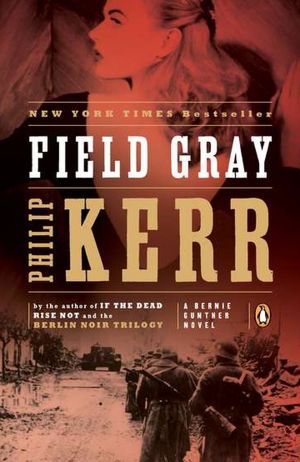
Book Review: Field Gray by Philip Kerr


Field Gray
By Philip Kerr

     This novel has been nominated by The Mystery Writers of America for the prestigious Edgar Award for best mystery novel of 2011.   While the book is good, I think calling this a mystery is somewhat of a stretch.  Field Gray is really a political thriller in the mold of John Le Carre or Robert Ludlum.  The main character is Bernie Gunther, a Berlin police detective turned private eye who joined the SS 1940 even though he never joined the National Socialist Party and didn’t consider himself a Nazi.  We meet Bernie in 1954 in Cuba.  He is working for the mobster Meyer Lansky and is captured by the U.S. Navy while taking a boat to Honduras.

     Bernie is interrogated by the F.B.I. at Guantanamo and then by the C.I.A. at a secret facility in New York state.  It is known that Gunther is a war criminal and a fugitive from justice, but the questions center around his relationship with a pre-war German communist named Erich Mielke.  Gunther and Mielke both served in Hitler’s SS in Berlin and on the Western Front.  By 1954 Mielke has become the commander of the East German secret police. 

     Gunther is transferred to Germany’s Landsberg Prison and he is held in the same cell which housed Adolf Hitler.   While at Landsberg, French and American agents try to pry information from Gunther.  He deftly plays one intelligence service against another.  The story is told in flashback style with chapters containing the interrogations alternating with Gunther’s remembrances of his various war time experiences.  These included fighting Russians on the Western Front, suffering as a Russian P.O.W. and serving as an intelligence officer in France.  These discontinuous time sequences are distracting at best and more confusing than seems necessary.

     Somewhere along the line a plot is hatched with the C.I.A. to deliver Mielke to the Americans in exchange for Gunther‘s freedom.  The conclusion involves more double and triple crossing activities.
The plot of this book is very difficult to follow.  There are no “good guys” and “bad guys” in this story (perhaps one explanation for the title), just a cadre of morally ambiguous folks looking after their own best self-interests.   I didn’t find this book as entertaining as Le Carre and almost gave up on it on several occasions.  I was glad that I read to the conclusion, however, because the ending almost makes the mental exercise of trying to follow the circuitous plot worth it.

Friday, November 18, 2011

Book Review: The Widow of the South by Robert Hicks


The Widow of the South
By Robert Hicks

Reviewed by Tom Carrico

(Blogger Note: This review was previously published in LAMLight, the physician newsletter of the Lynchburg Academy of Medicine and was referenced in a previous blog post book review of Devil's Dream by Madison Smartt Bell.)

      Just when you think there could be no more untold stories of the American Civil War, along comes a gem of a book: Robert Hicks’ The Widow of the South.  This book is set in Franklin, Tennessee, the sight of a brutal battle five months before Lee’s surrender at Appomattox.  The Battle of Franklin has been described by some as the bloodiest five hours of the Civil War.  Confederate General John Bell Hood decides to attack well entrenched Unions troops led by Major General John Schofield in an attempt to recapture Nashville.  Over the protests of other officers, including Major General Nathan Bedford Forrest, General Hood orders an ill-advised open field uphill infantry charge reminiscent of Pickett’s Charge at Gettysburg.  This leaves thousands of dead soldiers and many more severely wounded.  The battle descriptions are very vivid and well told. (Indeed they are the equal of Charles Frazier’s descriptions of the Battle of the Crater in “Cold Mountain”.)  This novel is much more than a war story, however.  It is the narrative of war’s effects on the country, the soldiers and the citizens who are swept up in its enormity.
      
     The main character of the book is Carrie McGavock.  She is the mistress of a failing plantation known as Carnton (interestingly enough, from the Gaelic for “place of the dead”).  We meet her pre-battle as she suffers from severe melancholy, having never emotionally recovered from the premature death of three of her children from various fevers.  Her husband John is a dysfunctional gentleman farmer who has never adapted to the “changes” brought on by the War and cannot deal with Carrie’s depression.  He has invested heavily in “the Cause” and suffers financial defeat and loss of his lifestyle and livelihood. 

     The mansion at Carnton is commandeered as a Confederate field hospital by General Forrest and Carrie springs to life in her new role.  The hundreds of wounded and dying soldiers who arrive on her doorstep following the Battle of Franklin enable her to find a purpose for her life beyond grieving her losses.  One particular soldier catcher her eye.  He is Sergeant Zachariah Cashwell from Arkansas.  He somehow survives the charge up the hill as a color bearer, only to be taken prisoner and then shot while trying to escape.  He has a potentially mortal thigh wound but is saved when Carrie triages him to the front of the surgery line and a high leg amputation is performed.  Zachariah is initially resentful of his survival and Carrie’s role in it, preferring death over life as a crippled amputee.  Their relationship grows from one of anger and distrust to one of mutual respect and admiration and finally, love.  This continues until Zachariah is well enough to be taken away from Carnton as a prisoner of war. 

     The rest of the book relates the story of Franklin after the War.  The town is repaired, train lines are extended, freed slaves become small business owners and farms are reclaimed, however there lingers much despair and bitterness over personal losses suffered during the War.  One citizen who owns the land which was the Franklin battlefield decides to plow over the field, disrespecting the final resting place of thousands of Confederate soldiers.  Carrie fights a verbal and political battle over this decision.  Finally, Carrie and John and a corps of volunteers exhume all of the bodies and re-bury them in the Carnton garden adjacent to the graves of the dead McGavock children.  Carrie catalogues the identity and location of each body.   She then dedicates the remainder of her long life to the maintenance of this cemetery and communication with each of the families involved, hence, obtaining the title of “The Widow of the South”.   The inevitable late-life reunion with Zachariah Cashwell is poignant and brings this novel to a satisfying conclusion.

     This book is made even more remarkable by the secondary characters who are wonderful in their own rights.  These include Mattie, Carrie’s slave (a childhood “gift” from her father) and Mattie's son Theopolis.  Mattie is the “heart” of Carnton, organizing and basically running the household for the inept McGavocks.  The dilemma of the freed slaves is played out by these characters who have never known another life.  Mattie decides to stay at Carnton with Carrie following the War and receives criticism from other former slaves including her own son.  Theopolis opts to move to town and becomes a very successful cobbler. 

     This is a novel of war for sure, but it is much more.  It is a story of grief and despair, hope and faith and discovery of life’s purpose.  Trying times forge character and cement relationships which last a lifetime. 

     This is a work of fiction, but the characters of Carrie and John McGavock as well as  Mattie and Theopolis are real.  Carnton exists and survives today with its adjacent cemetery thanks to the work of a non-profit organization.  The author is a Board member of this organization and his passion for and dedication to this project shines through on every page.  This is a startlingly good story which is incredibly well told.


Sunday, October 9, 2011

Book Review: Devil's Dream by Madison Smartt Bell


(Blogger Note: This review was published in the October, 2011 issue of LAMLight, the newsletter of the Lynchburg Academy of Medicine)


  This is a fascinating historical novel depicting the life of Nathan Bedford Forrest.  As a Virginian all of my life, the American Civil War has always been an interest.  I guess it can be forgiven if as a child growing up during the Civil War Centennial I thought the majority of the war was fought in Virginia, with the occasional foray into Maryland and Pennsylvania.  Spending eighteen years in Richmond reinforced that notion.  Driving past the statues of Stonewall Jackson, Robert E. Lee and Jeb Stuart every morning on Monument Avenue makes one think that all of the major personalities fought or died in Virginia.  It has been almost astonishing to me to learn that the “War of Northern Aggression” was fought fiercely all over the South and that there were major players elsewhere that deserve historical mention alongside Lee, Stuart, Longstreet and Jackson. 

   Madison Smartt Bell is a native of Tennessee (I wonder if he thinks the whole war was fought in his state?) and received his M.A. from Hollins College.  He now lives in Baltimore and teaches at Goucher College.  He is known for meticulously researched historical fiction and his eighth novel,   All Soul’s Rising, was a finalist for the National Book Award in the 1990s. 

   Nathan Bedford Forrest is an intriguing figure.  He came from modest means and made a fortune before the war with land investment and as a slave trader.  He enlisted in the Confederate army as a private and rose to the rank of Lieutenant General by war’s end. He had no military training but devised aggressive cavalry techniques and maneuvers.  He often argued with his better trained superiors over tactics.  The most famous disagreement was with General John Bell Hood preceding the Battle of Franklin, Tennessee, ground covered very well in The Widow of the South by Robert Hicks.

  The author does an outstanding job of capturing the contradictions in Forrest’s life.  He shows him courting his high society wife and treating her with great respect while abusing his female slaves.  Forrest showed great admiration for many blacks, including several as his closest advisers during the war and yet could sell and beat these same fellow humans seemingly without remorse.  He is alleged to have allowed a massacre of black Union soldiers at the Battle of Fort Pillow rather than take them prisoner, although this novel makes it seem as if the massacre was beyond Forrest’s control. 

   The author uses a second main character, a free black named Henri who encounters Forrest at the beginning of the war, to tell much of the story.  Henri is a Haitian who came to New Orleans with the intention of igniting a slave revolt.  Henri serves Forrest as a scout and soldier until he is killed at the Battle of Chickamauga.  Through Henri’s eyes we see Forrest go berserk in the heat of battle:  charging into enemy lines with a double edged sword in one hand and a six shooter in the other.  He often had multiple horses (often as many as three or four) shot out from under him during these reckless charges.  We see Forrest shot, stabbed, beaten and starved.  In one memorable scene, Forrest is confronted by another general who Forrest has accused of cowardice.  The second general pulls a gun and shoots Forrest at point blank range.  Henri sees Forrest fall, assumes he’s dead and then watches in amazement as Forrest jumps up and runs after his would-be assassin yelling “Nobody kills Nathan Forrest and deserves to live!”

   The secondary characters are important and abundant in this novel as well.  Nathan’s wife Mary Ann is attracted to her husband’s audacity and brashness but is equally embarrassed by his occupation as a slave trader and by his not so subtle indiscretions with his slave mistresses.  Mary Ann’s mother lives with the couple for some time and acts as an over-bearing and outspoken conscience.  She repeatedly stirs up ill feelings within the extended Forrest family.  Forrest’s many brothers play significant roles, both at home in Memphis and as battlefield advisors.

    I have only two criticisms of this book.  The first criticism is the chronology (or lack thereof) with which it is written.  It’s like the author wrote the story in proper sequence but then cut and pasted the individual chapters in a random order.  A chapter describing intense fighting in Franklin, Tennessee is likely to be followed by a chapter describing Forrest first meeting Mary Anne and her mother while rescuing them from a wagon trapped in a creek bed.  I tried to decipher the reason the author did this, but I couldn’t figure it out.  It becomes very confusing when the battle sequences are presented out of date order.  The second criticism is that the author does not include or even mention Forrest’s post-war life.  The fact that he survived is unbelievable.  How Forrest rallied against carpetbaggers  became the first Grand Dragon of the Ku Klux Klan would certainly (in my opinion) have added a lot to this character’s life story.  But, this is not a biography and the author had to stop somewhere, so maybe this isn’t a valid criticism. 

  Devil’s Dream is a superbly written historical novel with a fascinating and enigmatic main character.  History and Civil War buffs should really enjoy this book.