Showing posts with label Edgar Award. Show all posts

Tuesday, April 23, 2019

2019 Best Novel Edgar Award - Updated


     Only to Sleep by Lawrence OsborneThe Liar's Girl by Catherine Ryan HowardHouse Witness by Mike LawsonDown to the River Unto the Sea by Walter Mosley,  A Gambler's Jury by Victor Methos and A Treacherous Curse by Deanna Raybourne are the six novels nominated for the 2019 Best Mystery Novel Edgar Award.  I have reviewed each individually and you can read those reviews by clicking on each link.  The Mystery Writers of America announced the 2019 winner on April 25.  My pick is as follows:

     First let me say that I enjoyed every one of these novels and that is not the case for all Edgar nominees in previous years.  Each novel has its unique strengths and every one was entertaining.  Here's a condensed review of each nominee:


     The quality of the writing and the ringing clarity of the descriptions of everything from the characters to the setting keep the reader turning the pages even when the plot lags a bit.  Staying true to the "bewilderingly dreamlike plots" of Raymond Chandler makes the pace of this almost glacial in spots.  The splendid writing, however, saves the day.


     Set in Victorian London, this book is a cat and mouse game of puzzling clues and misdirection.  The book has exciting twists of plot and a tumultuous ending.  A Treacherous Curse was the one novel of the six which I though I would enjoy the least, but it was great.  I read it quickly and would recommend it highly.


     The setting for A Gambler's Jury is Salt Lake City and its surrounding counties.  This is a nice change from the usual Los Angeles or New York locales for mystery novels.  The author, a seasoned criminal-defense and civil-rights lawyer himself, deftly describes the peculiarities of the justice system in Utah.  The characters are all very human and very believable.  The ending has a neat twist of plot which was actually fairly predictable almost from the outset.  I enjoyed A Gambler's Jury and found it to be a very worthy nominee for the 2019 Edgar for best mystery novel.  I will look forward to reading other books by this author.


     Mike Lawson actually has you rooting for the bad guys (although who the bad guys are in this book is a fluid notion).  The plot is so believable, the characters are so exceptionally well developed, the pace is so fast (though not hurried) and the dialogue is so genuine that the book is nearly impossible to put down.  Add to this the New York setting and in my opinion you have the perfect crime novel!  If Ed McBain was alive and writing, he would have written House Witness.  This book is that good!


     Read Down the River unto the Sea by Walter Mosley for the spectacular writing.  Read it because of the astute social commentaries contained within.  Read it because it is a great story.  Read it because it may very well be the 2019 Edgar Award winner for the best mystery novel of the year.  Just read it!


    This is a serial killer story with a twist.  A man is in jail for murders committed ten years ago.  When new murders occur, are they copycats or is the wrong man in jail?  I really enjoyed the author's descriptions of Dublin and Cork, two places I have never been but would love to visit.  They added a lot to what is a very enjoyable and entertaining mystery.  This is a worthy nominee for the 2019 Best Novel Edgar.  


     I enjoyed every one of these novels.  They are all worthy of nomination and any could win the Edgar for Best Mystery Novel.  My pick, however, would be Mike Lawson's House Witness.  The combination of tight plotting, great dialogue and superb character development made it my favorite.  My second place (and just as good, really) is Walter Mosley's Down the River Unto the Sea.  We will see which is the actual winner later this week!

   Well, I was half right.  The Mystery Writers of America chose Walter Mosley's Down the River Unto the Sea as the 2019 Edgar Award Winner for the Best Mystery Novel.  I can't disagree but would reiterate that all of the nominees were worthy of nomination and quite capable of being the award winner.


Thursday, April 27, 2017

The 2017 Best Novel Edgar Award - My Choice


The 2017 Best Novel Edgar Award - My Choice


Five novels published in 2016 have been nominated for the 2017 Edgar Award by the Mystery Writers of America.  The winner will be announced on April 27, 2017.  I have read and reviewed the five novels on this blog and now will pick my winner.  I will up date this blog on the 28th and we will see if I agree with the experts!

These are the five nominees, hyperlinked to my reviews:


The reality is that I liked all of these books.  There was not a single dud in the bunch.  I would recommend them all.  But, somebody has to win and somebody has to lose this award, so here are my rankings:


#5:


     This book was really good.  I appreciated the way the author incorporated a lot of modern technology into the story.  The characters were well developed but not very likable.  The plot was a bit convoluted for me, but the ending made sense.  All in all, a worthy nominee, but not my winner.

#4: 


     What Remains of Me was clever with interesting characters but I thought suffered from a bit of a convoluted plot.  The resolution of the story was surprising.  Again, a worthy nominee, but not my winner

#3:


     This book pretty much had it all: interesting and sympathetic characters, a well paced and believable plot and a satisfying conclusion.  My only gripe here was that the ending was a bit predictable.  I also thought that the media types presented here were a bit stereotypical.  Nit-picky complaints, though, given the great quality of this book.


#2:


     This book had great characters but could have had maybe a little tighter plot.  I thought that it dragged in sections.  That said,  I probably would have picked this as my Edgar winner in most years.


My Winner:


     If you had asked me before I had read any of these books, I would undoubtedly ranked this book last.  I had no expectations for this and thought that I would hate it.  Boy, was I wrong.  The writing is superb.  The plot moves along and the characters are all incredibly well developed.  I enjoyed every page of this book and was genuinely sad when I finished it.  This is not your typical "mystery novel", but is my winner by a long shot.  We'll see what the Mystery Writers of America have to say later tonight!

Update:  The Mystery Writers of American announced that Noah Hawley's Before the Fall won the Best Novel Edgar for 2017.  I can't argue with that at all.  Again, I thought all five books were  excellent and would recommend them all!  T.C.

Monday, September 1, 2014

Book Review: Queenpin by Megan Abbott


Queenpin

Author: Megan Abbott
Publisher: Simon and Schuster
Date of Publication: June 5, 2007
Pages: 196

     This is a stellar crime novel by multi-faceted author Megan Abbott.  This is classic crime noir with a familiar "good girl gone bad" plot.  What sets this book apart is that the central characters are both women.  It is told in the first person by an unnamed young woman longing to escape her meager background.  She is recruited by Gloria Denton, a notorious mobster who acts as a mentor of all things corrupt.  The young woman's educations is moving right along as she transports cash, betting slips and information between race tracks, betting parlors and offices.  She makes a critical error by falling for Vic Riordan, a slick lady's man and perpetual loser.  Major complications ensue as Vic uses our femme fatale for his own nefarious purpose.  
  
  This book is written in a compact, no words wasted style which evokes the best of James M Cain and Mickey Spillnae.  There is graphic violence here as well as a constant undertone of sexual tension.  The writing itself is spectacular, conjuring the styles and fashions of the times.  An example from an early exchange between Gloria and her protege:
     
    "She looked at me in that icy way of hers.  Then in a flash of the hand, she tugged open her crepe de chine jacket, buttons poppping.  There, on her pale, filmy skin, skeined over with thready wrinkles, I saw the burn marks, long, jagged, slipping behind her bra clasp, slithering down her sternum."  

     This is writing strong enough to earn this author a Best Paperback Original Edgar Award in 2008.  Megan Abbott has also been nominated for the Steel Dagger, The L.A. Times Book Award and The Pushcart Prize.  The lady can write.  If you are a crime fiction fan, especially the classics, you will surely enjoy Queenpin.

Tuesday, September 18, 2012

Book Review: Gone by Mo Hayder


Gone
Author: Mo Hayder
Publisher: Grove/Atlantic, Inc.
Pages: 416 (NOOK Edition: 396)) 
Publication Date: February 1, 2011 


      Mo Hayder is a British mystery and thriller author who has written eight novels to much acclaim.  Gone is the fifth in a series featuring Detective Jack Caffery and was selected by the Mystery Writers of America as the 2012 Edgar Award Winner for best mystery novel.  I usually tend to agree with the Mystery Writers, but not in this case.

     Gone follows Detective Caffery's investigation of several car-jackings.  These are far from routine auto thefts, however, because in each case a young girl is in the car when it is stolen.  The need to find these children as quickly as possible adds another dimension of tension to an already nerve-wracking story.  There are several sub-plots working here as well which make the plot a bit more involved than it need be.  

     The story is told from Jack Caffery's perspective as he chases down false leads and tries to find connections between the seemingly unrelated crimes.  There are many other characters involved, including other police, parents of the abducted children, witnesses and persons of interest.  Caffery is portrayed as a tortured, lonely soul who labors under the weight of unsolved crimes and feelings of inadequacy.  There isn't much back story to substantiate these feelings except for one unsolved missing celebrity case which he suspects may involve one of his co-workers.  (I haven't read the other four books in this series, so maybe the reasons for Caffery's angst is in those.)  With each new crime in the series the tension is ratcheted up, but a whole new set of players are introduced.  I think the plot is weighted down by too many minor characters.

     The author does a tremendous job of using setting as a method of creating atmosphere and tension.  There is a creepy abandoned wharehouse, a railroad tunnel and lots of lonely English countrysides searched which add a lot to the menacing tone of the entire novel.  Here is one paragraph as an example of this.  A female detective is inspecting an area near where one of the stolen cars had been abandoned:
     "She went to the old water tank where she had been standing and switched off the torch.  She waited for a few quiet moments, surrounded by the monster shapes of the winter trees, beyond them the ploughed fields stretching away, dull, immense and dead.   From somewhere in the distance to her right came the giant sound of a train racing along the Great Western Union Railway, flying through the darkness."

     The strength of this book is the descriptions of setting and place.  The weaknesses, in my opinion, come from too many characters which aren't developed to any great degree, a plot which becomes weighted down by all of these characters and has too many unresolved secondary stories and, finally, a criminal whose motivation doesn't really fit the magnitude of his crimes.  Gone is very worth reading for mystery fans and is much better than more hyped mystery fiction (e.g, Gone Girl by Gillian Flynn).  I just don't agree with the Mystery Writers of America that this was the best mystery novel published in 2011.

Wednesday, March 14, 2012

Book Review: 2005 Edgar Award Winner: California Girl by T. Jefferson Parker


California Girl
 T. Jefferson Parker
  
     California Girl is a fantastic crime novel set in Southern California, the locale for all of T. Jefferson Parker's many entertaining novels.  This author has been nominated three times for the Best Novel Edgar Award.  This is his second winner, the first being Silent Joe.  If you have never read one of Parker’s books before, you don’t know what you are missing.  He transcends the genre of mystery novel, as his books have great depth and are not pure crime novels or mysteries.  Like Silent Joe, this book is a tremendous character study.  Actually, there are multiple character studies which intertwine and interact.  California Girl is also a re-creation of an era and a place: late 1960s Orange County, California.  While this is not a historical novel, the appearance of many non-fictional characters makes this an even more interesting read.  These include such disparate characters as Richard Nixon, Timothy Leary and a hyperactive and wild rock and roll drummer named Charles Manson.
  
     The story is set up in the 1950s.  Two families feud after their sons are involved in a rumble outside of the California Girl orange packing plant.  The Becker family (four sons) is respectable, church-going and hardworking.  The Vonns (three boys, one girl) on the other hand, are from “the other side of the tracks”, literally and figuratively.  They are more interested in motorcycles, alcohol and drugs than more mainstream pursuits.  The one daughter involved, Janelle Vonn, grows up to win regional beauty contests and rises above her sordid upbringing.  The eldest Becker son is killed in Viet Nam and the remaining three mature into a minister, a newspaper reporter and a police officer.  The Vonn brothers remain outside the law, engaged in everything from illicit drugs to stolen goods.  The two family stories intersect again in 1968 when the decapitated body of Janelle Vonn is found in the now deserted orange packing plant.  Each of the three Beckers investigates Janelle’s killing from his own perspective.   Further clashes with the surviving Vonns are inevitable.  A conviction is finally secured and the alleged perpetrator is incarcerated.  The Beckers are never really satisfied with this and thirty years later the case is brought to a startling and unexpected conclusion.  Dirty politics (a Parker staple) play a major role in the resolution of the story.

     This book has it all: great characters which are well developed, a twisting but plausible plot with unexpected turns, a spectacular Southern California setting which the author obviously knows and loves and interesting historical tidbits thrown in for good measure.  I enjoyed California Girl by T. Jefferson Parker immensely and recommend it highly.  This novel is more than worthy of the 2005 Edgar Award which it received.


Tuesday, February 28, 2012

2007 Edgar Nominee: The Pale Blue Eye by Louis Bayard


The Pale Blue Eye
By Louis Bayard

 
     The Pale Blue Eye was a nominee for the 2007 Edgar for best mystery novel as selected by The Mystery Writers of America.  Louis Bayard has constructed a magnificent tribute to the master himself, Edgar Allan Poe, the great American author who is regarded as the inventor of the detective story. 

    This novel is set in 1831 at the United States Military Academy at West Point.  A cadet is found suspended from a tree by a noose.  It appears to be a suicide, but some of the circumstances don’t add up.  Shortly after the body is brought to the hospital for autopsy it is desecrated.  Someone brutally removes the heart from the corpse.  The purpose of this act is as baffling to the authorities as the death itself and puts the suicide hypothesis in severe doubt.  The commandant calls in retired New York City detective Augustus Landor to investigate.  Confidentiality is stressed as Landor accepts the challenge of solving the crime.  An odd, older cadet comes to Landor’s attention and he enlists this cadet as a spy of sorts, a mole to acquire inside information from within the Academy.  The older cadet is none other than Edgar Allen Poe.  Poe is an eccentric, sleeping little, disobeying rules at every opportunity and channeling poetry from his dead mother.  He is convinced that these poems hold clues to the identity of the killer.  The sense of urgency to solve the crime is heightened when yet another cadet dies and his heart is stolen as well.  The investigation focuses on the family Dr. Marquis, the Academy physician.  The doctor’s son Artemus is an upper classman and a close friend of the first victim.  Mrs. Marquis is a peculiar woman prone to disabling headaches and inappropriate bizarre behavior.  The centerpiece of this dysfunctional family is Miss Lea Marquis, a not quite beautiful spinster.  At the age of 23 she no longer is viewed as a potential spouse for the younger cadets, but she does catch the eye of Cadet Poe.  Poe has a habit of including poetry with the reports he prepares on his clandestine research for Landor.  One of these works speaks of “the pale blue eye” which happens to match the eye color of Miss Lea.   The motive for these crimes remains as much a mystery as the identity of the killer, but the removal of the hearts makes Landor assume that there may be a Satanic cult at work.  Indeed, some of Poe’s information supports that hypothesis.  The book moves along through this interplay between Landor and Poe, the case against the Marquis building with each page.  Suspicion shifts from one Marquis family member to another and eventually falls even on Cadet Poe.  The ending is totally unanticipated and surprising, although in retrospect, completely believable.  There are clues to the mystery’s solution, although there are an equal number of distracters from the actual perpetrator as well.  The construction of this story is very clever indeed and I, for one, never saw the true ending coming.

     The Pale Blue Eye is a monument to Edgar Allen Poe.  Not only is he a key character in the plot, but the story itself pays homage to the greatest Poe traditions.  It is told in the first person by Detective Landor.  This is the same perspective which Poe uses in most of his stories.  The story is very dark with a lot of the action occurring at night, much like Poe’s.  Louis Bayard uses the same sorts of imagery as Poe to set tone.   The drum beats of the morning cadet assembly casts a sense of foreboding and is reminiscent of the heartbeat in “The Tell Tale Heart”.  There is a scene towards the end of the book where the author creates a fatal cascade of ice which evokes the final fiery scene from “The Fall of the House of Usher”.  Poe uses dangerous and frightening water in stories such as “Silence – A Fable” or in the novel The Narrative of Arthur Gordon Pym and Bayard uses the turbulent Hudson River in the climactic gripping conclusion to this novel.   Indeed the subject matter here, ruthless and barbaric murders without clear motive, is reminiscent of “The Murders in the Rue Morgue”.  Imbibing of excess alcohol is a problem for Mr. Landor, as it was for this fictional and the real-life Edgar Allan Poe.    

     This is a historical novel of the first order.   The writing is comparable to the best prose of Poe himself.  The descriptions and details are meticulous and create vivid visual images for the reader.  The first person perspective makes the reader become almost part of the story.  Landor addresses the reader directly in several passages.  You are led from one area of suspicion to another and yet the resolution of the plot at the end is as shocking and surprising as it is tragic.   

     The author has carefully researched the history of West Point.  The characters, including Colonel Thayer and Commandant Hitchcock, are historically correct.  Edgar Allan Poe was, indeed, a cadet at West Point in 1831.  He enlisted there shortly after his foster mother passed away and was dismissed after only one year.  The murders are pure fiction.

Sunday, February 19, 2012

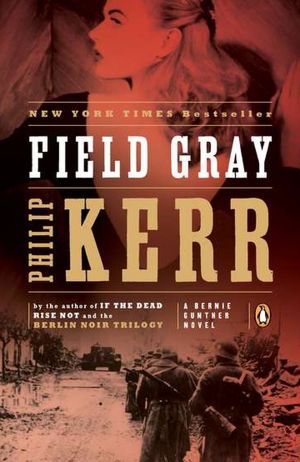
Book Review: Field Gray by Philip Kerr


Field Gray
By Philip Kerr

     This novel has been nominated by The Mystery Writers of America for the prestigious Edgar Award for best mystery novel of 2011.   While the book is good, I think calling this a mystery is somewhat of a stretch.  Field Gray is really a political thriller in the mold of John Le Carre or Robert Ludlum.  The main character is Bernie Gunther, a Berlin police detective turned private eye who joined the SS 1940 even though he never joined the National Socialist Party and didn’t consider himself a Nazi.  We meet Bernie in 1954 in Cuba.  He is working for the mobster Meyer Lansky and is captured by the U.S. Navy while taking a boat to Honduras.

     Bernie is interrogated by the F.B.I. at Guantanamo and then by the C.I.A. at a secret facility in New York state.  It is known that Gunther is a war criminal and a fugitive from justice, but the questions center around his relationship with a pre-war German communist named Erich Mielke.  Gunther and Mielke both served in Hitler’s SS in Berlin and on the Western Front.  By 1954 Mielke has become the commander of the East German secret police. 

     Gunther is transferred to Germany’s Landsberg Prison and he is held in the same cell which housed Adolf Hitler.   While at Landsberg, French and American agents try to pry information from Gunther.  He deftly plays one intelligence service against another.  The story is told in flashback style with chapters containing the interrogations alternating with Gunther’s remembrances of his various war time experiences.  These included fighting Russians on the Western Front, suffering as a Russian P.O.W. and serving as an intelligence officer in France.  These discontinuous time sequences are distracting at best and more confusing than seems necessary.

     Somewhere along the line a plot is hatched with the C.I.A. to deliver Mielke to the Americans in exchange for Gunther‘s freedom.  The conclusion involves more double and triple crossing activities.
The plot of this book is very difficult to follow.  There are no “good guys” and “bad guys” in this story (perhaps one explanation for the title), just a cadre of morally ambiguous folks looking after their own best self-interests.   I didn’t find this book as entertaining as Le Carre and almost gave up on it on several occasions.  I was glad that I read to the conclusion, however, because the ending almost makes the mental exercise of trying to follow the circuitous plot worth it.

Tuesday, February 7, 2012

2010 Edgar Nominee: Faithful Place By Tana French


Faithful Place
By Tana French

 (Blogger Note: This review was previously published in "LAMLight," the physician newsletter of the Lynchburg Academy of Medicine.)
     
     Forty pages into this book I assumed this would be my favorite of the 2010 Edgar Nominees.  The book is set in Dublin and features the mother of all dysfunctional Irish families.  The main character is an undercover detective named Frank Mackey.  His father is an alcoholic (surprise!) and abusive.  His mother is the typical Irish mother who is a master at sending her children on guilt trips.  Frank has an older and younger brother and sister.  The story opens with nineteen year old Frank waiting for his girlfriend Rosie Daly.  Their plan is to escape their lower class life and neighborhood by running away to London.  The only problem is that Rosie never shows up.  Frank finds part of a note Rosie wrote implying that she was taking off for London on her own.  Young Frank leaves Faithful Place behind also, relocating in Dublin and becoming a well-respected undercover police officer.  He marries, has a daughter, becomes divorced and never attempts to contact his parents or is siblings.

     Twenty two years later Rosie’s suitcase is found in an abandoned home on Faithful Place.  A search of the basement finds the remains of a young woman which is eventually identified as Rosie Daly.  The ultimate “cold case” becomes Frank’s obsession, despite being warned by superiors to stay away from the investigation. 

     The plot segues from the present day back to the events leading up to Frank and Rosie’s ill-fated rendezvous twenty two years previous. Frank also reluctantly reacquaints himself with his estranged family .  The list of suspects begins to narrow when Frank’s younger brother Kevin apparently jumps from an upper story window in the same abandoned house where Rosie’s body was found.  The police find a tidy explanation for both deaths:  Kevin was her killer and took his own life in remorse.  Frank, however, is not buying any of it. 

     As Frank digs into his past, he finds even more “skeletons”.  He narrows the field of suspects down to the unthinkable – other members of his own family. 

     This book is extremely well written.  It could, however, have used a bit of editing.  There is one whole chapter where Frank tries to explain death to his nine year old daughter which seemed unnecessary.   The perpetrator of the crimes is fairly obvious early on, but the way the plot resolves at the conclusion is very clever.  I thoroughly enjoyed Faithful Place.

Thursday, January 19, 2012

The Edgar Awards and a Book Review: The Lock Artist by Steve Hamilton


     The Mystery Writers of America, founded in 1945, annually presents the Edgar Awards for mystery fiction, non-fiction, television, film and theater published or produced in the previous year.  The nominees are always announced on January 19, the birthday of Edgar Allan Poe.  Poe is generally recognized as the “father” of the mystery novel.    Today is the 203rd anniversary of the birth of Poe and the announcements of all of the Edgar nominees are included here: (2012 Edgar Nominations).   The Edgar nominees for the Best Mystery novel of 2011 are:

-          The Ranger by Ace Atkins
-          The Devotion of Suspect X by Keigo Higashino
-          1222 by Anne Holt
-          Gone by Mo Hayder
-          Field Gray by Philip Kerr

     To celebrate the announcement of this year’s nominees, here is a review of the 2011 winner: The Lock Artist by Steve Hamilton.  This review was previously published in “The LamLight”, the physician newsletter of the Lynchburg Academy of Medicine.


 The Lock Artist by Steve Hamilton

This novel is a truly unique and intriguing read.  The story is narrated in the first person by the main character, a young adult named Michael.  Michael suffers a major psychological trauma as an eight year old which leaves him literally speechless.  This trauma is alluded to early on and is revealed in detail at the conclusion of the story, a riveting chapter which ties up all of the plot’s loose ends.
We meet Mike as a struggling junior in a large high school in a town about forty miles from Detroit.  He has not spoken a word since age 8 and is seen as the class freak.  He is a very accomplished art student and can sketch in great detail.  He is living with an uncle who owns a liquor store.  Quite by chance, he learns that he is very good at picking locks.  He finds some old locks in an antique store and becomes fascinated by their mechanism, eventually teaching himself how to open any lock, including combination locks.  His skill is discovered by some of the more popular students in his school who recruit him to participate in a prank – breaking into the home of a rival school’s star football player and leaving a derogatory sign in the student’s bedroom.  Vandalism occurs, the police arrive, the perpetrators scatter and the only one apprehended is Michael.  He refuses to reveal the other students involved and a probation/restitution deal is worked out.  Michael has to work the entire summer for the well-to-do homeowner who was victimized by the vandalism.  He is a sadistic sort and has Michael dig a pool in his backyard using only a small shovel.  Michael becomes enamored with the man’s daughter who is also very artistic and a love affair ensues. 
The homeowner is in some economic difficulties, owes money to the mob and sees Michael as a possible solution to his problems.  He involves Michael with these criminals and the rest of Michael’s story is a series of break-ins where his safe-cracking abilities are well utilized.  The story of Michael’s criminal life is interwoven with the story of how he was introduced to this life in a very intricate but effective way.
The tragedy which caused Michael’s communication issues is revealed in a very innovative way at the end of the book.  Between assignments for the mob, Michael tracks down his former girlfriend who is now attending the University of Michigan.  They return to Michael’s childhood home which is now abandoned and together they draw a huge mural which depicts the events leading to Michael’s issues.
The Lock Artist is very entertaining.  It is told in the first person by the mute main character as a memoir which he is writing from jail.  The plot moves forward at a constant but not a rushed pace and switches back and forth between Michael’s life of crime as a young adult and his adolescence..  The writing is very engaging; the author even makes all of the details about the construction and design of different types of locks interesting.  I thoroughly enjoyed this book and recommend it highly.