Thursday, June 4, 2020

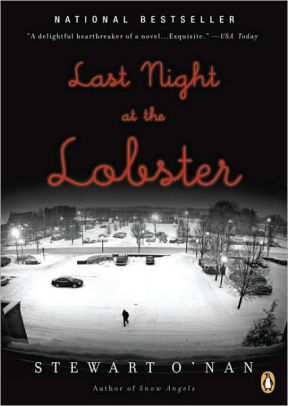
Book Review: Last Night at the Lobster by Stewart O'Nan


Last Night at the Lobster


Last Night at the Lobster

Author: Stewart O’Nan
Publisher: Penguin Group (USA)
Date of Publication: November 1, 2007
Pages: 160

Some authors write great epics about heroic people.  Others write about ordinary people in extra-ordinary circumstances.  I’ve always admired authors who could tell stories about ordinary people and their every-day lives and make those stories interesting.  It’s an added bonus if the author can make those same stories humorous, poignant and thought provoking at the same time.  Anne Tyler is one of those authors.  So is Stewart O’Nan.  In this novel Stewart O’Nan creates a culture of average lower middle class workers and restaurant customers who collectively tell an all too familiar story of displacement, insecurity and anxiety.  He introduces these characters quickly but deftly and uses dialogue to help us know and understand them like they were old friends. 

Last Night at the Lobster is O’Nan’s twelfth novel.  He also has several non-fiction titles to his credit, including one he co-wrote with Stephen King about the Boston Red Sox.  The author grew up in Pittsburgh, went to undergraduate school at Boston University and now lives in Connecticut.  Small-town New England is the setting for this wonderful short novel.

The novel describes closing night for a marginally successful Red Lobster just off of an interstate highway in Connecticut.  Upper management has decided to close the restaurant instead of spending what it would take to remodel it.  The story is told by the Lobster’s long-time manager, Manny DeLeon.  Manny takes great pride in “his” restaurant and although he is grateful that he has been offered another job, he is not looking forward to the demotion to assistant manager at a new Olive Garden. 

The novel opens with Manny parking his dilapidated Buick Regal in the Lobster parking lot and smoking a joint before opening.  A major snowstorm is beginning as well.  Manny has to deal with his disgruntled employees, some of whom have been let go and four of which are following Manny to the Olive Garden.  There are petty jealousies among the waitresses and major attitude problems with the kitchen staff.

The rest of this short novel (or long short story) details the frustrations and disasters which occur on this last evening.  A large office party comes in and neither waitress wants them because large parties are notoriously bad tippers.  Two women have lunch with a totally undisciplined toddler.  The final blow comes right before closing when a busload of Japanese tourists come in to use the bathroom (the bus driver claims that they all got dysentery at a Red Lobster farther south on the interstate).

All the while Manny has to juggle a minimal inventory, malfunctioning equipment, a blizzard and employee insurrection.  Few of you know this about me, but I abandoned a career in the restaurant business to pursue medicine.  I had rocketed through the fast food industry and was the “Special Whopper” bench guy at the Falls Church Burger King when I realized there had to be a better way to make a living.  While in college I also worked for a year or so at Blackie’s House of Beef at 22nd and M Streets in D.C. (Anyone ever go there?  Remember the blue cheese and crackers before dinner?).   I can recognize some of my own restaurant experiences in this melancholy, but at times hilarious, novel. 

Last Night at the Lobster does have a purpose other than pure entertainment, however.  I think that the value of the book is that it points out the comfort of familiarity and the reassurance of routine.  The closing of this restaurant rocks Manny’s world, as well as that of all of the other characters in the book, including the regular customers.  Uncertainty and change do not always bring out the best in people, as this book demonstrates quite well.  One reviewer calls Last Night at the Lobster “a perfectly observed slice of working class life.”  This book was written and published long before this current economic crisis and job loss.  However, the author creates very real characters and uses dialogue superbly to tell a fabulous fable for our times. 

(Note: This Review was originally published in "LamLight", the physician newsletter for the Lynchburg Academy of Medicine in 2008)

Tuesday, May 19, 2020

Book Review: Descartes's Secret Notebook by Amir D. Aczel


Descartes’s Secret Notebook

Author: Amir D. Aczel
Publisher: Crown Publishing Group
Date of Publication: October 10, 2006
Pages: 288


            This fascinating and highly readable book is part biography, part mystery and part treatise on philosophy and mathematics.  Rene Descartes lived from 1596 to 1650.  His life was one of adventure and discovery.  His philosophy was hotly debated at the time and his discoveries in mathematics were and are regarded as genius.  This author tries to add another layer to the legend by examining a purported secret notebook, long lost but copied in part by German mathematician Gottfied Wilhelm Leibniz after Descartes’ death.

Rene Descartes was born to a wealthy family in the town of Chatellerault, France.  He was baptized in the Roman Catholic Church and remained a devout and loyal Catholic his entire life.  His mother died in childbirth a year later and Descartes’ own health as a youth is described as poor.  He received what we all recognize as the great advantage of a Jesuit education at what is now a military academy in the town of La Fleche, the Prytanee National Militaire.  He then received a doctor of laws degree in 1616 and moved to Paris.  In Paris he developed his interests in mathematics, physics and eventually, philosophy.  He also traveled extensively to the Netherlands and Denmark.  His health as an adult was much improved and he never lost his interest in the military.  He even joined the army of Maximilian, the duke of Bavaria, at the beginning of the Thirty Years War.  It was during this time as a volunteer soldier in Maximilian’s army that he began his studies and interpretations of geometry and science.  Eventually Descartes settled in Holland where his Cartesian philosophy created controversy.  Everyone is familiar with “I think, therefore I am” (or “Cogito, ergo sum”), but the basis for this definitive statement is a very concise, even mathematical, proof of the existence of God.  This was the time of turmoil between the Roman Catholic Church and the Protestant denominations and the acceptance of Descartes’ reasoning was not universal. He was even accused of the serious charge of atheism despite his devout Catholic heritage and practice.  Eventually Descartes became the philosophy instructor for Queen Christina of Denmark.  There were jealousies between Descartes and the Queen’s other instructors as Descartes quickly became the young Queen’s favorite.  The fact that the others were strict Calvinists played a role.  Descartes died under somewhat suspicious circumstances in Sweden in 1650.  There are suggestions that he may have been poisoned by a rival.  His belongings were catalogued and shipped to relatives in France.  Eventually many of his original documents, including the secret notebook alluded to in the book’s title, disappeared.

The secret notebook was a private notebook which Descartes never intended to publish.  He used codes and symbols that were indecipherable for centuries.  Part of this notebook was copied by Leibniz shortly after Descartes death and that is all that remains of the document.  Some historians felt that this notebook represented Descartes membership in a secret society, the Rosicrucians.  Others felt that Descartes had discovered the origins of the universe.  It was not until 1987 when Pierre Costabel published his definitive analysis of Leibniz’ copy of Descartes’ secret notebook that the true meaning of the secret notebook was revealed.  Descartes had discovered a coveted formula for a rule which governs the structure of three dimensional solid objects.  This was mystery which had eluded Plato and the other Greek geometricians as well as all other mathematicians in history.  He had discovered the modern field of topology centuries before its time.  The reason he repressed this discovery was because it supported Kepler and Copernicus and their analysis of planetary motion around the sun.  The timing of this coincided with the Roman Catholic Church’s prosecution of Galileo for heresy.  Descartes, the loyal Catholic, did not want to suffer the same fate.

There are many interesting side stories in this tale, including the simultaneous discovery of the calculus by Newton in England and Leibniz in Germany.  There may be a connection between these two men which would be, of course, Rene Descartes.  Descartes private life is examined as far as historical facts allow, including a possible marriage to a servant girl and a relationship of some sort with Princess Elizabeth of Bavaria who was living in exile in Holland at the same time as Descartes.  The exact relationship between Descartes and Queen Christina is a mystery as well.  At about age 40 Descartes noticed his first grey hairs.  He felt this was a sign of impending death and began dissecting animals by the hundreds in an attempt to discover the secret to a prolonged life.  He greatly altered his diet, becoming basically a vegetarian.

This is a fascinating book.  I remembered very little of Descartes from my Philosophy 101 class and this book made me wish I had paid more attention.  The historical aspects of this time are equally absorbing.  The author makes the mathematics understandable (not an easy task in my humble opinion) and the philosophy enjoyable.  

Rene Descartes
1596-1650


Monday, May 18, 2020

Book Review: Alabama Noir, edited by Don Noble


Alabama Noir

Edited by Don Noble
Publisher: Akashic Books
Date of Publication: April 7, 2020
Pages: 256 

This anthology is part of the Akashic Noir Series which began in 2004 with Brooklyn Noir. There are now over 100 books in this series from locations around the world and featuring many “name” authors as editors.  Each edition features writers from the area represented which lends great authenticity to the stories.  Alabama Noir is one of the latest books released and is edited by Emmy Award winning screenwriter Don Noble.

I was immediately impressed with the roster of authors included in this volume, mainly because of the diversity within it.  Out of the sixteen stories, five were penned by women and four by people of color.  Some of my favorite fiction writers are here as well, including Ace Atkins, Tom Franklin and Winston Groom.  In fact, I purchased this book because of a social media post by Atkins promoting his story “Sweet Baby”. 

In the Introduction Noble notes that Alabama of the 1960s was dominated by race issues and the civil rights movement.  He notes that unfortunately race problems still exist and points to the inadequacies in the justice system and in the state’s prisons.  There is movement towards coming to grips with the past and trying to move past this history as evidenced by the work of attorney and social justice advocate Bryan Stevenson and the establishment of the National Memorial for Peace and Justice in Montgomery.

Noble also gives a brief description of the Noir genre, using The Maltese Falcon as the gold standard example.  The three dominant themes of the genre include failed romance and femme fatales, greed and revenge, each with varying amounts of violence mixed in.  This anthology contains excellent examples of all three, with the added dimensions of racial discord and social inequality mixed in.

I enjoyed all of the stories, but I did have a few favorites.  The first was “Deep Water, Dark Horizons” by Suzanne Hudson, a native of Georgia but a longtime resident Mobile and Fairhope.  The story is set in Fish River.  An elderly landowner and a tenant (who are friends) argue over a broken septic system when the tenant rekindles an old flame on the internet.  The landowner is described:

                “It was his mind-set, to be wary.  The older he got, the less he trusted folks, even old friends. He had just about stripped away anyone who ever mattered to him, stripped away with suspicion, always, of ulterior motives.”

Another favorite was “What Brings You Back Home” by Michelle Richmond who was raised in Mobile.  In this story a mom and widow whose child and husband were killed in a mass shooting who seeks and takes revenge on a Senator who voted against gun control.  Another example of a superb story is “The Junction Boys” by D. Winston Brown an author from Ensley, Alabama who now lives in Birmingham.  Here a young veteran returns home to confront his first girlfriend’s father who sexually abused her.  The character’s state of mind is described:

                “The information at first swirled around Colesbery’s head, then he felt that twitch in his stomach that always came before a mission.  The plan materialized in his brain – how he would do it, when he would do it, where he would do it.  He rubbed his eyes and then stretched his fingers wide, balled them tight, stretched them again, and settled back in the moment.”

                This is a magnificent collection of short stories.  You don’t have to be a noir fan to appreciate the great writing and captivating characters.  Even the more violent stories are not graphic.  I was thoroughly entertained from start to finish.  I am encouraged to purchase more of the books in the Akashic Noir series.

Wednesday, March 18, 2020

Book Review: The Butchering Art by Lindsey Fitzharris


The Butchering Art

Author: Lindsey Fitzharris
Publisher: Farrar, Straus and Giroux
Date of Publication: October 17, 2017
Pages: 304

"New opinions are always suspected, and usually opposed,
without any other reason but because they are not already common."
- John Locke


     The Butchering Art is a totally captivating work of creative non-fiction, made even more remarkable by the fact that it represents the first book written by author Lindsey Fitzharris.  The author received a PhD. in the History of Science, Medicine and Technology from Oxford University in 2009.   Honors awarded to The Butchering Art include: Winner of the PEN/E.O. Wilson Prize for Literary Science Writing, Top 10 Science Books of Fall 2017 by Publisher's Weekly and a Best History Book of 2017 by "The Guardian."  In addition to this novel, the author has written for “The Guardian”, “The Lancet” and “New Scientist.”  She has a huge social media presence including a fascinating blog: "The Chirurgeon's Apprentice".  You can also follow her on Facebook at https://www.facebook.com/DrLindseyFitzharris/ but be prepared for some graphic posts!  She also has many multi-media projects in progress including a British Television Series: "Medicine's Dark Secrets". 

     The Butchering Art is first and foremost a biography of Joseph Lister.  Lister was born on April 5,1827 in Wetsham, Essex, England to devout Quaker parents.   His father, Joseph Jackson Lister was a great devotee of the microscope and developed the "achromatic lens" which reduced distortions.  Young Lister was very interested in his father's microscope and became proficient in its use.  He announced he wanted to be a surgeon, at that time a profession held in low regard.  He attended the University College of London, beginning in 1844.  Lister was noted to be hardworking and diligent, despite the poor reputation of medical students of the day (who were described as “lawless, exuberant, and addicted to nocturnal activities” in one journal).  Lister brought a microscope with him although the use of that instrument in medical studies was more accepted in Paris than in London.  The author describes the conditions in the medical school in the 1840s.  First, there was no protective gear in the “dissecting rooms” or anatomy labs.  Students routinely went directly from their cadavers to their living patients without so much as washing their hands.  Also, there were two schools of thought in the field of infectious disease: Contagionists, who believed in an "agent of disease" vs. Anti-contagionists, or miasmatists, who believed that diseases were transmitted through the air via poisonous vapors.  Only four types of infections were recognized: eryspielas, hospital gangrene, pyemia and septicemia.  Post-operative infections were routine and mortality rates were very high.

     The author spends one chapter discussing the rapid urbanization and increased population density in London.  These conditions set the stage for more injuries and illnesses.  Lister was frustrated at the high mortality associated with surgery and was intent on finding the cause of infection and used his microscope to investigate.  He felt that something in the wound itself had to be at fault, not just the air around the patient.  Lister: "I examined microscopically the slough from one of the sores, and I made a sketch of some bodies of pretty uniform size which I imagined might be the materies morbi (morbid substances).  The idea that it was probably of parasitic nature was at that early period already present in my mind."

      Lister completed his surgical training and sat for examinations by the Royal College of Surgeons.  It was recommended that he tour European medical schools to learn more about recent advances.  His first stop on this tour was the University of Edinburgh to study with James Syme, renowned professor of surgery.  Syme had achieved quite a bit of notoriety for his economy of technique and time which he tried to achieve with nearly every form of operation he undertook.  Syme took special interest in Lister, who decided to stay in Scotland instead of pursuing appointments in London or resuming travels to Europe.  Lister was elected to membership in The Royal College of Surgeons of Scotland and advanced on staff of Dr. Syme.  Also, during this time he courted and married Syme's oldest daughter.  Lister then began a series of experiments on frogs to study effects of inflammation on wound healing.  He discovered that "a certain amount of inflammation as caused by direct irritation is essential to primary union.  Inflammation of a wound did not necessarily presage sepsis."  These are concepts which are central to wound healing physiology today.

     Lister applied for the position of Regius Professor of Clinical Surgery at the University of Glasgow and was recommended by Dr. Syme: "Lister has a strict regard for accuracy, extremely correct powers of observation and a remarkably sound judgment united to uncommon manual dexterity and a practical turn of mind."  While in Glasgow, Lister grew increasingly frustrated by his inability to prevent and manage septic conditions in his patients.  His case notes catalogue the questions plaguing him:  "11 P.M.  Query.  How does the poisonous matter get from the wound into the veins?  Is it that the clot in the orifices of the cut veins suppurates, or is poisonous matter absorbed by minute veins and carried into the venous trunks?"  He became an advocate of cleanliness in the hospital, even though his method for antisepsis was still to come.  At the same time as Lister was studying inflammation and infection, there were many surgeons in Europe interested in the high maternal post-partum mortality from "puerperal fever."  Alexander Gordon in Scotland wrote in 1789 that puerperal fever was secondary to contamination by the medical staff.  This idea was summarily rejected.  Oliver Wendell Holmes in America revived Gordon's ideas fifty years later and Ignaz Semmelweis in Vienna spoke of "cadaverous particles" which could be transmitted through medical students from the anatomy labs to the obstetrical wards.  He instituted a chlorine hand wash when leaving the anatomy lab and reduced incidence of puerperal fever.  In the 1840's it was proven that cholera was caused by contaminated sewage and not "miasma" or bad air and changed the view of how diseases spread.  In France, chemist Louis Pasteur showed that bacteria ruined fermentation in wine.  Finally, Lister applied this knowledge to the septic wound and proposed the application of antiseptic agents (first potassium permanganate and then carbolic acid) which greatly reduced the infection rate in surgically treated compound fractures.  Lister published his findings in “The Lancet” with a five-installment article which began on March 16, 1867.

     Lister's concepts and method were not immediately accepted.  There was conflict with James Y. Simpson, a noted gynecologist and the discoverer of Chloroform anesthetic.  First Dr. Simpson wrote a letter to “The Lancet” claiming Lister was only repeating studies already performed in Europe and secondly that his own method of preventing infection, acupressure, was more effective.  Lister repeatedly defended antisepsis, pointing to the strict scientific method with which he had reached his conclusions.  Lister's method was also rejected by another distinguished London surgeon, James Padgett, who did note, however, that he might not have been applying the method correctly.
     
     In 1869 Dr. Syme passed away and Lister returned to Edinburgh to take his place.  There was still a debate regarding the efficacy of Lister's method.  Improved mortality rates were attributed to better ventilation, improved diet and improvements in nursing rather than antiseptic technique.  However, Lister's students became believers and marveled at Lister's continued experimentation and constant adjustments to his antiseptic technique.  His students, who came to be known as "Listerians", realized the value of experimentation in medicine and that observational acuity and accuracy could lead to improvements in surgery.  Lister's method gained traction with surgeons in Europe, particularly Richard von Volkmann in Germany and gradually gained acceptance in Britain.  Lister then went on to develop the atomizer, a device to spray carbolic acid into the air to reduce bacteria.

     In 1871 Lister was called to care for Queen Victoria who was suffering with a large axillary abscess.  He used his carbolic acid atomizer on the Queen and then drained the infection.  When he noted further drainage on the first post-operative day, he improvised a new treatment.  He soaked some rubber tubing in carbolic acid and placed it into the wound.  The Queen recovered and this was the first use of a surgical drain!

      In 1876 Lister was invited to speak in America where his methods were greeted with much skepticism.  His presentation in Philadelphia was criticized by Samuel Gross: "Little, if any faith, is placed by any enlightened or experienced surgeon on this side of the Atlantic in the so-called treatment of Professor Lister."  Listerism gradually gained acceptance in America and Massachusetts General became the first hospital in America to make institutional use of carbolic acid as a surgical antiseptic.  Lister's method became universally accepted during his lifetime.  He died in 1912 as a hero of medicine and science.

     Interestingly, the change which occurred in surgery through Lister's efforts have been immortalized in the art of Thomas Eakins.  Dr. Gross, who had espoused the contrarian view to Listerism in Philadelphia, commissioned a painting by Eakins entitled "The Gross Clinic":


 In this painting, Dr. Gross is operating on the femur of a young man with osteomyelitis.  There are unsterilized instruments displayed and one of the surgical assistants is seen probing the wound with his bare and bloody fingers.  Twenty years later Eakins painted "The Agnew Clinic":


In contrast, this painting shows the embodiment of antisepsis and hygiene.  It is a cleaner and brighter surgical theater with the surgeons wearing stark white coats rather than street clothes.             


     The Butchering Art is a meticulously researched scientific exercise and yet it reads like a novel.  It is one of those rare books which educates and at the same time entertains.  It is a biography of Joseph Lister, a history of medicine as it struggles to enter the modern age, a historical monograph describing London, Edinburgh and Glasgow in the mid 1800's and a socio-economic treatise describing urbanization, poverty and social injustice in the Victorian era.  It is a long book, but I recommend it highly.  Dr. Fitzharris' next book will be a similar treatment of Sir Harold Gillies and the development of the specialty of reconstructive plastic surgery.


Wednesday, March 11, 2020

Book Review: Truth Over Fear: Combatting the Lies about Islam by Charles Kimball


Truth Over Fear: Combating the Lies About Islam

Author: Charles Kimball
Publisher: Westminster John Knox Press
Date of Publication: August 20, 2019
Pages: 158

     This little book is exactly what it purports to be.  It is a primer of basic and accurate information about Islam and gives the reader a fundamental knowledge base to be able to begin to comprehend the broad similarities as well as the intrinsic differences between Islam, Christianity and Judaism.  More importantly, Truth Over Fear allows the reader to listen critically to politicians, news media and other speakers and be able to spot the distortions and misrepresentations (as well as outright untruths) about Islam.  We used this book in our adult Sunday School at Outer Banks Presbyterian Church to begin a study of comparative religions and to initiate a program to promote inter-faith dialogue in our community.  The book was very successful in stimulating constructive, positive discussions and understanding about Islam.

     Charles Kimball is the Presidential Professor and Chair of the Department of Religious Studies at the University of Oklahoma in Norman, Oklahoma.  He has extensive experience living and working in the Middle East and has worked tirelessly to promote interfaith understanding and dialogue.  He has written other books which are useful in small group settings, including When Religion Becomes Evil: Five Warning Signs, published in 2008.

     In the author's Introduction, he discusses the misinformation promulgated by politicians, religious leaders and others and suggests that we need a new paradigm for thinking about and interacting with Muslims.  In the first chapter he gives us constructive religious responses to Islamophobia and discusses the Biblical mandate for positive interfaith relationships.  Chapter Two gives a very good explanation of the Five Pillars of Islam.  The Five Pillars are: Statement of Faith, Five Daily Prayers, Fasting, Alms Giving and Hajj, or holy pilgrimage.  Kimball in this chapter also iterates the similarities and differences between Islam and Judaism as well as Christianity.  He stresses that Muslims consider their God (the Arabic word for God is Allah) to be the same God of Abraham and Isaac.  Muhammad's revelations from God are thought to be the final ones in the line that started with Abraham and continued through Moses and the Prophets of the Old Testament and Jesus in the New Testament.  Jesus is seen as one of the great prophets but in Islam, Jesus is not considered divine (neither is Muhammad).  Islam does not believe in the Resurrection of Jesus and does not believe in the Trinity.  The Five Pillars, however, stress many of the fundamental concepts of the Judeo-Christian tradition, taking care of the less fortunate being just one.

     Chapter Three is entitled: "Conflict and Cooperation" and traces the development of attitudes towards Islam, Muhammad and Muslims in general from the time of Muhammad (around 620 A.D.) until the late 20th Century.  In a very succinct summary, Kimball presents the geographic, economic and political forces which created a fearful and extremely hostile perception of Islam in Europe.  The writings of Dante and Martin Luther are used as examples of the negative dialogue which prevailed.  Enlightenment and Post-Enlightenment thought represented a softening of the negative rhetoric about Islam, but the stereotypical representations of Islam as militant and evil remained.

     Chapter Four is entitled "The World We Actually Live In" and stresses the complexity of the world's religions (including Islam) today and how few people (especially those in charge of foreign policy) understand these complexities.  Kimball states that generic remedies for real or perceived problems include thinly veiled racism or bigotry aimed at groups deemed inferior (such as Muslims) and that people faith and goodwill must be willing to challenge the easy stereotypes and deeply rooted biases about Islam and its 1.7 billion followers.  We saw in the previous chapter how these stereotypes and biases evolved over centuries.  In this chapter the author discusses the diversity in Islam including the differences between Sunnis and Shi'ites and even differences within these sub-groups.  He also gives a cincise definition of Sharia and Jihad and clears up many misconceptions about both.  He ends this chapter with a discussion of Islam in America.

     The concluding two chapters enumerate how interfaith dialogue and improved relations have been attempted on an international scale and how that can be brought to the community and congregation level.  Kimball notes how the Christian mission mandate has changed over the last 50 years which corresponds to the great ecumenical efforts of the World Council of Churches and the Roman Catholic Church through the directives of Vatican II.   Mission work is now seen as an ecumenical effort to witness, serve and dialogue rather than proselytize and convert.  Interestingly, Islam is also a missionary religion which comes directly from the Five Pillars.

     Kimball does not ignore the radical Muslim extremists responsible for the attacks of 9/11 as well as the horrible activities in Afghanistan and elsewhere.   He discusses this and notes that other religious traditions (including Christianity) have extremists as well.  He notes that "Knowing something of the fullness of one's own religious tradition makes it easier to continue to think generically of its ideal and assign repugnant behavior to the marginal extremes."  In other words, it's easy to dismiss these extremists as "not true Christians" or "not true Muslims".  The author further states: "you cannot remove large groups of people with whom you disagree from your broader religious community."  In order to understand these concepts of extremism and how to react to it, our class is next going to study Reza Aslan's Beyond Fundamentalism: Confronting Extremism in the Age of Globalization.  Stay tuned for more on this topic.


     In summary, Kimball's book is an excellent starting point.  If you stop here you will have a basic understanding of Islam and be able to confront the erroneous statements made by less informed individuals.  It is also a great jumping off point to learn more about the world we live in today.  I recommend it highly.

Sunday, February 23, 2020

Book Review: After the Plague by T.C. Boyle


After the Plague

Author: T. C. Boyle
Publisher: Viking Adult
Date of Publication: September 2, 2001
Pages: 256 (Hardcover)


     This eclectic collection of short stories is about as good as it gets.  There are sixteen collected tales here which range from poignant to sublime.  Each story is packed with eccentric characters in difficult and often very odd situations.  There are normal people thrust out of their comfort zones,  older folks not coping with loneliness and depression and young lovers failing to accept or even realize the consequences of their actions.

     Stories are told from unique points of view, some from minor characters and even one narrated by a deceased spouse!  What is the constant in these stories is the superb writing: word craft of the highest order.  The opening sentences grab the reader and thrust you smack into the middle of the tale.  Consider this opening sentence from "Friendly Skies":

     "When the engine under the right wing began to unravel a thin skein of greasy, dark smoke, Ellen peered out the abraded Plexiglas window and saw the tufted clouds rising up and away from her and knew she was going to die."

     Even though this collection is a bit dated (published almost twenty years ago) the author has showcased timeless issues: anger management, sexism, ageism, class status and struggles with unmet expectations in relationships.  The star of this collection, though, is the writing which is timeless.  I highly recommend this collection and anything else written by this superb author.

Tuesday, January 21, 2020

Book Review: The Room of White Fire by T. Jefferson Parker


The Room of White Fire

Author: T. Jefferson Parker
Publisher: Penguin Publishing Group
Date of Publication: August 22, 2017 (Hardcover)
July 3, 2018 (Paperback)
Pages: 352

     T. Jefferson Parker is an accomplished author who has won 3 Edgar Awards: Best Mystery Novel Edgars in 2002 (Silent Joe) and 2005 (California Girl) and a 2009 Best Short Story Edgar for Skinhead Central.   I have read and enjoyed a number of his earlier books, including the two award winners, but have not read any of his recent work.  That will change after reading The Room of White Fire.

     This book starts a new series featuring former Marine, former boxer, former sheriff and current private investigator Roland Ford.  Ford is hired to find a young Air Force veteran who has escaped from a private Southern California psychiatric facility.  Clay Hickman is the escapee from a facility named simply Arcadia.  He is also the son of a prominent local builder and a veteran of war in the Middle East.  He harbors dark secrets from his time in the service.

     As Ford begins his investigation he encounters a wide cast of characters, including Hickman's psychiatrist, fellow patients at Arcadia and some shady security people at the facility.  He finds out that Arcadia is owned and operated by Briggs Spencer, a former military psychologist who literally wrote the book on enhanced interrogation techniques (water boarding, etc...).  Spencer worked as an independent contractor during the war on terror.  Ford eventually pieces together that Hickman did not spend his time in the service in Iraq as everyone, including his family, believed, but was in Romania at a secret prison and interrogation facility working for Briggs. 

     What follows is a three dimensional cat and mouse game between Ford, Hickman and Briggs and his security forces.  Fearing what Hickman knows and is willing to expose, Briggs is willing to go to any lengths to silence him.  Ford is the proverbial man in the middle.  The truly anguishing part of The Room of White Fire is the descriptions of the tortures inflicted in Romania and the long lasting effects it has had on the perpetrators.  This is an uncomfortable fact that the author boldly confronts.

     Like in his award winners, Parker uses Southern California as his canvas.  His descriptions of San Diego and the county lend a steady realism to this fast paced story.  His characters are all complex and well developed.  They each have their own set of demons.  Since this is the first installment for Roland Ford, the author tells us a lot of his backstory, all of which is interesting and adds dimension to this otherwise prototypical "tough guy" investigator.

     I'm glad that I re-discovered T. Jefferson Parker.  While The Room of White Fire doesn't really approach Silent Joe or California Girl (or Laguna Heat for that matter) it is a splendidly written story with an important social message to boot!