Wednesday, August 21, 2013

Book Review: Zeitoun by Dave Eggers


Zeitoun

Author: Dave Eggers
Publisher: Knopf Doubleday Publishing Group
Date of Publication: June 15, 2010
Pages: 325 (Trade Paperback)

"The whole place was anarchy."


     This book makes me furious.  It makes me mad at prejudice and profiling, chaos and circumstance; mad at policy and ignorance.  It makes me mad at people who do their job without thought of humanity or reason and yes, mad at God.  I'm even mad that not everyone in this country has read this book and been as outraged as I am.  I'm mad.

   Zeitoun should be required reading for every bureaucrat and politician and anyone else who may have a hand in shaping policy for disaster response and recovery.  This should be required reading for every police chief, National Guard and military officer who may participate in disaster relief.  It should be read by every American, especially those bellicose politicians and civil libertarians who pride themselves on being protectors of our freedoms.

    This book is the true story of Abdulrahman and Kathy Zeitoun.  Abdulrahman (or "Zeitoun" as he is called) was born in Syria, worked for years at sea and settled in the United States.  He is a naturalized citizen who met his American wife at a mosque in New Orleans.  Kathy converted from being a Southern Baptist before meeting Zeitoun.  Together they built a family and a successful painting and contracting business.  The story unfolds as Hurricane Katrina approaches and then devastates the Gulf Coast.  Kathy and the children flee while Zeitoun stays behind to protect his business and properties.  The author uses flash backs of Zeitoun's childhood and family in Syria as well as his experiences as a naturalized American citizen to create a tremendously sympathetic character.  

   The book follow the humble and God-fearing Zeitoun as he tries to do the right thing by his neighbors and fellow citizens.  What transpires is the most remarkably outrageous transgression of human rights imaginable.  In the UNITED STATES OF AMERICA!  In 2005!!!  My God, there are passages here that read like they are taking place in Nazi Germany or Stalin's Soviet Union.  Where was I when this was happening?  Where was anybody that cares about human beings for that matter?  Zeitoun is not an indictment of Republicans or Democrats, Muslims or Christians, blacks, whites or Syrians.  It is an indictment of human nature, the abrogation of responsibility and the lack of human-ness in the face of disaster.  Zeitoun has been compared to Kafka's The Trial, but it actually reminded me more of a modern day Book of Job, except Zeitoun has more resilience than Job.  The most amazing part of this story is that despite events which would have destroyed the strongest of individuals, Abdulrahman never loses hope and never loses faith in his God.  Zeitoun is a truly remarkable man.

    Truman Capote is generally credited for inventing the genre of "creative non-fiction" with the phenomenal In Cold Blood.  Dave Eggers has taken this genre to a whole new level with this monumental work.  Read this book.  Be as mad as I am.


Friday, August 16, 2013

Book Review: Joyland by Stephen King


Joyland

Author: Stephen King
Publisher: Titan
Publication Date: June 4. 2013
Pages: 288 (Trade Paperback Edition)


     I’m not a huge fan of this author, but every five years or so I pick up and read a Stephen King novel.  Sometimes I am intrigued by the premise (Needful Things) and am disappointed by the resolution of the plot and other times I am interested in the topic (capital punishment in The Green Mile) and am pleased with King’s take on that topic.  I picked up Joyland for several reasons.  First, I admired the author’s refusal to release the book in electronic format, instead promoting the perpetuation of the physical book.  Secondly, this novel was released as part of the “Hard Case Crime” series, a celebration of the crime noir genre which I have enjoyed for years.  The books in this series are inexpensive paperbacks with classic “pulp fiction” covers released by The Dorchester Publishing Company.  The series includes the re-release of classics by James M. Cain, Donald Westlake and Ed McBain as well as new efforts by contemporary writers such as Stephen King.
     
      The major rediscovery for me while reading Joyland was that Stephen King can really write.  He is noted for his horror fiction (Carrie, Pet Semetary, The Shining, etc.) but his writing transcends that genre and his prose ranks right up there with the best contemporary authors.  In Joyland he evokes the sights, sounds and feel of the early to mid-1970s.  He uses the music of the time (most notably The Doors and Pink Floyd) so set the tone of the story and the sometimes dour mood of Devin Jones, the main character.  He describes North Carolina beaches so perfectly that the reader can feel the breeze off of the ocean.  King also includes a lot of carnival lore including the peculiar idioms used by veteran “Carny” workers which lends an authenticity to the story.  

     The plot revolves around Devin, a college student from New England who spends a summer working at an old fashioned amusement park on the coast of North Carolina.  He is suffering from the recent breakup with his college sweetheart while he adapts to the culture of the South.  There is a decades old murder mystery entwined as well as some supernatural goings-on (this is a Stephen King novel, after all) including a haunted funhouse ride.  There is also the underlying mystery of how some people are always in the right place at the right time (a familiar King theme).  Is it chance or is there a mystical rhyme and reason for coincidence?  There are numerous secondary characters including a precocious child with Duchenne Muscular Dystrophy who contribute greatly to this moving story.  Joyland is not a breathlessly paced mystery, nor is it a shocking horror thriller.  It is a totally enjoyable, entertaining novel with a satisfyng ending.  It is a very well thought out and exquisitely written novel which I enjoyed reading very much.

Friday, August 2, 2013

Book Review: Beautiful Ruins by Jess Walter


Beautiful Ruins

Author: Jess Walter
Publisher: HarperCollins
Date of Publication: June 12, 2012
Pages: 368 (Nook edition) 


     What a pleasant surprise this novel was.  When it was first published in 2012 I read a brief blurb about its premise: a beautiful but terminally ill actress shows up unexpectedly in a small Italian fishing village.  I immediately dismissed it from my list of potential reads.  Even though I read the author before (Edgar Award winner Citizen Vince) and enjoyed that book very much, this sounded too much like a romance novel for my taste.  However, I kept seeing the book showing up on "Best Books of (fill in the blank)" lists.  It was like this book kept presenting itself to me telling me to read it.  So I did.

     The author does a splendid job of juggling multiple plot lines in two different time periods.  It's really like two novels woven into one.  Walter does this so seamlessly that there is never any confusion about what is going on or when.  He brings the two story lines together spectacularly at the end.

     The novel does begin with the maudlin premise of a dying young actress appearing mysteriously at a remote Italian fishing village.  She stays at a former brothel which a young Italian fellow is trying to re-invent as a hotel and vacation destination for "rich Americans".  The novel does indeed evolve into a love story of sorts, but an unpredictable and richly satisfying one.  The plot elements include Hollywood legend (the making of "Cleopatra" in Rome in the early 1960s) and current Hollywood wheeling and dealing.

     The author has also constructed an admirable ensemble cast of colorful characters, not the least of which are Elizabeth Taylor and Richard Burton.  The main characters in the first story (set in 1962) turn out to be the actress and the Italian hotelier, his extended family including a grieving mother and devious aunt and a motley bunch of fisherman and villagers. The main characters in the second story (set in the present day) are an aging movie producer and his ambitious and frustrated assistant.  The character that unites the two stories is the aforementioned actress.  How the author does this you need to read the book to find out.

     Beautiful Ruins cleverly sneaks in a repeated moral cunundrum for the reader to pause and ponder.  Through the stories of these varied characters, the author constantly poses this philosophical question: should humans act on impulse and satisfy their needs or should they always strive to do the right thing, even if the results of that action do not satisfy their wants or needs?  In the immortal words of the young hotelier's widowed mother: "It's best if what you want and what is best are close to the same thing."  For all of these characters, however, that is not always the case and uncomfortable choices need to be made.  Although it seems like the choices should be clear, more often than not, they aren't. 
 
     Jess Walter has many strengths as an author, all on display in Beautiful Ruins.  The plotting is superb, paced perfectly and with enough suspense to keep the pages turning quickly.  The characters he has created are engaging and, despite their many flaws, very likable.  His writing is very evocative and descriptive but he is able to do this with an economy of words.  The dialogue is genuine and gives insights into the characters and their motivations.  Finally, he is able to mix in just the right amount of humor and irony in order to amuse as well as entertain the reader.   

     Beautiful Ruins now scores a place on another "Best Of" list:  this is one of the best novels which I have read in a long, long time!

Saturday, July 27, 2013

Book Review: Death in the City of Light by David King


Death in the City of Light

Author: David King
Publisher: Crown Publishing Group
Date of Publication: June 5, 2012
Pages: 462 (Trade Paperback Edition)


     Death in the City of Light is a disturbing look at a fascinating side story to the Nazi occupation of Paris.   It begins with a grisly discovery of dismembered bodies in various stages of decay in an up-scale neighborhood of the 16th Arrondissement of Paris.  This discovery sets off a search for the strange and puzzling owner of the building who promptly disappears. 

     The book is an attempt to define or describe Dr. Marcel Petiot.  He is a medical doctor whose past as well as his life in Paris is cloaked in mystery.  The author has done painstaking research into Dr. Petiot’s entire life story in order to help the reader try to understand the incomprehensible.    He also includes many contemporary accounts of the investigations of the despicable crimes for which the doctor was eventually tried and convicted.   The author cleverly leaves unanswered (as does history) the conundrum of which of two stories is true.  The first story (expounded at the criminal trial) is that the doctor was a merciless killer who lured innocents into a trap by promising them a road to freedom from the Nazis.  He instead stole all of their belongings, tortured them and then dismembered and disposed of their bodies.  He had a history of mental illness and there arose some question as to whether the doctor was in fact insane.  There was speculation that he had indeed also killed his first wife years before.  The second story as told by the doctor as his defense is that he was a master of deception, working for a faction of the French Resistance, did indeed help people escape to Argentina and was framed by the Gestapo.  There is some corroboration of the Doctor’s version of events.  The author presents all of the available evidence for both stories.

     There are other notable characters whom the author fleshes out in detail, including the police inspector, Dr. Petiot's wife and brother (accomplices or naive relatives?) as well as many of the victims who disappeared.  These secondary characters add a lot of texture to the story of Dr. Petiot.

     It is very interesting to read of the attempts at justice and proper police investigation by the French during the chaos of Nazi occupation.  It is also interesting to read a about a murder investigation which took place many decades before the availability of forensic studies such as DNA analysis which we so take for granted. Death in the City of Light is a fascinating book, although at times the author sacrifices pace and readability for comprehensive reporting.  The character of Dr. Petiot is portrayed as somewhat of a “Dr. Jekyll and Mr. Hyde”  which rings true whichever story you as the reader want or come to believe.


Thursday, July 18, 2013

Book Review: Flee by J. A. Konrath and Ann Voss Petereson


Flee

Authors: J. A. Konrath and Ann Voss Peterson
Publisher: Thomas and Mercer
Date of Publication: October 10, 2012
Pages: 241 (Kindle Edition)

         To say that this book is awful does disservice to awful.  I rated it one star on Goodreads.com because that's the lowest rating a reader can give a book.  If I could have given it negative stars I would have.  This came as somewhat of a surprise since I have read several of J. A. Konrath's "Jack Daniels" series and enjoyed them.  They had a semblance of a plot and some character development as well as some humor, none of which shows up here.

     This book has a preposterous premise and the plot line is a giant chase scene through and around Chicago.  There are multiple clones of the main character (all of whom are female and named after male mystery writers: Chandler,  Hammett, Clancy, etc...).  There is violence galore and one explicit random sex scene.  What is missing is a plot, character development and humor.  Did I mention that the writing sounds like it came from a drop out from an on-line creative writing course?  Every page, it seems, has the main character noticing at least three smells ("Creative Writing 101: Have your characters use all of their senses").  The only real mystery here is why I read this whole book.  I guess that I somehow thought it would get better.  Maybe, like watching the TV news coverage of a natural disaster, you get sort of numb to how bad it is.  I don't know.  I've probably read worse books but I don't remember when.

Monday, July 15, 2013

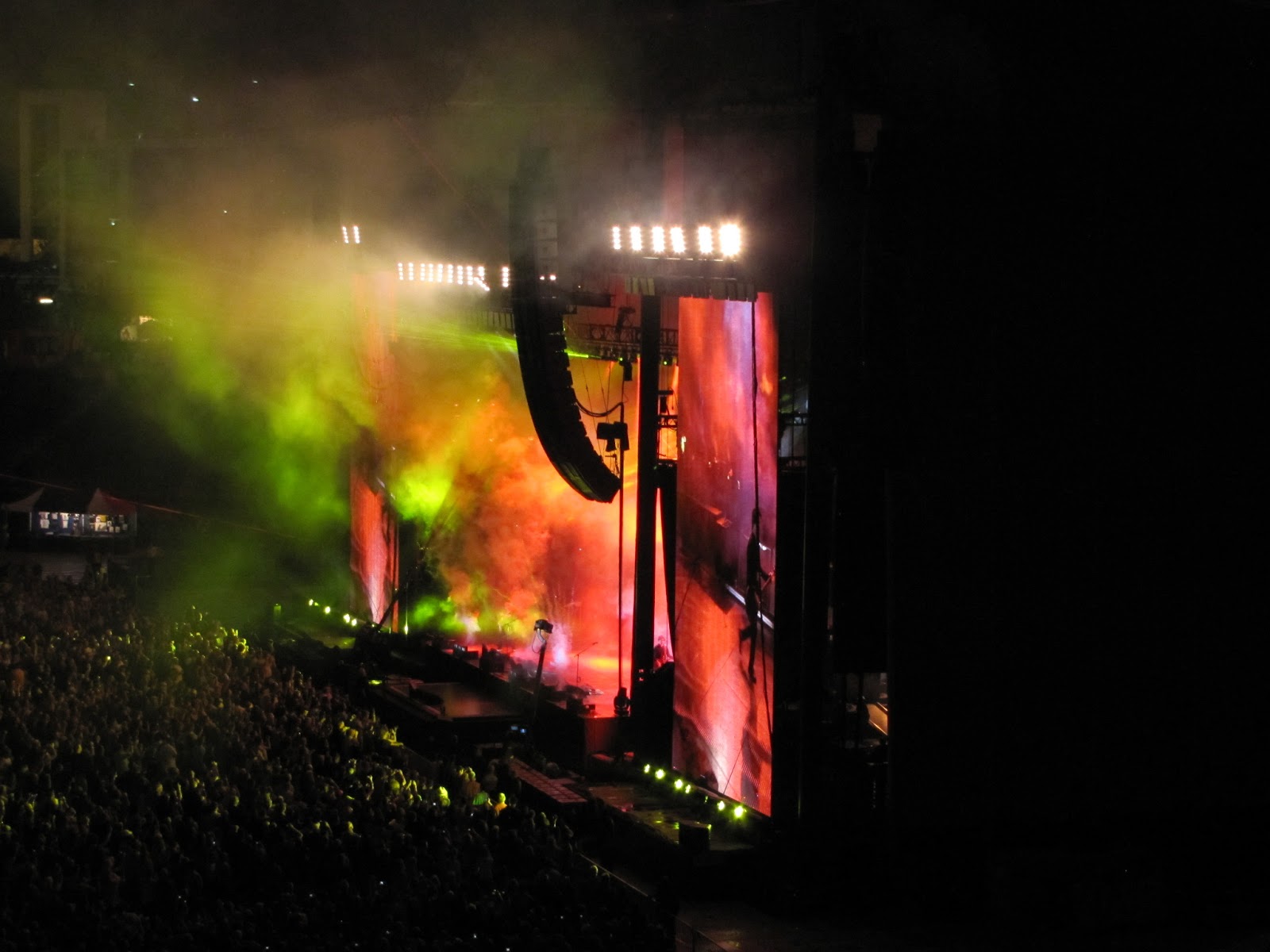
Paul McCartney at Nationals Stadium, Washington, D.C., July 12, 2013


Paul McCartney

"Out There Tour"

Nationals Stadium, Washington, D.C.

July 12, 2013


     I am afraid that Sir Paul McCartney may have ruined rock concerts for me forever.  I think that any show I could ever see would pale in comparison to the virtuoso performance at Nationals Stadium on July 12.  First and foremost, Paul McCartney has created a body of work with no equal.  His music has staying power as evidenced by the huge number of young people at this concert.  His songs energize, entertain and amaze.  And they keep coming.  One after another he pulled out gems which delighted the enormous crowd.  From the set list I have included below, you can see that this was no nostalgia-fest.  He mixed in recent compositions as well as old favorites.

     I was asked yesterday to pick the one highlight of the show which I would experience again if I could.  That was a difficult task.  After a bit of reflection, that one highlight above all other highlights would have to be Paul's tribute to George Harrison.  He played George's "Something", starting out by himself on the ukelele and then joined by his whole band for a truly touching performance.  After the crowd hysteria quieted down a bit, Paul broke the somewhat maudlin tone by quipping "And to think Frank Sinatra said that was his favorite Lennon-McCartney song!"

     Performers take a significant risk performing a set list of such familiar songs.  The crowd knows every lyric, every guitar solo, every harmony, every drum beat (Admit it: you have "air-drummed" Ringo's solo from "Abbey Road").  One slip-up and all 50,000 people in the audience will know it.  Well, Paul McCartney and this amazing band hit every note.  Every harmony was pitch-perfect.  The timing on every song was dead on.  The precision and perfection with which these songs were delivered was truly a wonder.

     Paul McCartney is the consummate entertainer.  From the opening D-E-G, D-E-G jangle of "Eight Days a Week" through the pyrotechnics of "Live and Let Die", the poignant renditions of "Something" and "Yesterday", the raw energy of "Helter Skelter" to the coda of the ending medley from "Abbey Road" the crowd was engaged, energized and entertained.

   Wow!  What a show!


SET LIST

1. Eight Days a Week
2. Junior's Farm
3. All My Loving
4. Listen to What the Man Said
5. Let Me Roll It (Foxy Lady)
6. Paperback Writer
7. My Valentine
8. Nineteen Hundred and Eighty Five
9. The Long and Winding Road
10. Maybe I'm Amazed
11. I've Just Seen a Face
12. We Can Work It Out
13. Another Day
14. And I Love Her
15. Blackbird
16. Here Today
17. Your Mother Should Know
18. Lady Madonna
19. All Together Now
20. Lovely Rita
21. Mrs. Vanderbilt
22. Eleanor Rigby
23. Being for the Benefit of Mr. Kite!
24. Something
25. Ob-La-Di, Ob-La-Da
26. Band on the Run
27. Back in the U.S.S.R.
28. Let It Be
29. Live and Let Die
30. Hey Jude

Encore 1

31. Day Tripper
32. Hi, Hi, Hi
33. Get Back

Encore 2

34. Yesterday
35. Helter Skelter
36. Golden Slumbers
37. Carry That Weight
38. The End

(NOTE: I do apologize for the quality of the photos.  The camera policy on the ticket read "no cameras with detachable lenses" so I brought a point and shoot Canon digital camera with a 20x zoom.  The resolution on these photos leaves a bit to be desired, but I included them anyway to give readers a feel for the visual spectacular that accompanied the musical one)

"Helter Skelter"

Friday, July 5, 2013

Movie Review: The Lone Ranger


"The Lone Ranger"

Starring: Armie Hammer, Johnny Depp
Directed By: Gore Verbinski

Studio: Walt Disney Pictures

    "The Lone Ranger" opened July 3 to universally lukewarm reviews.  There have been many criticisms,  not the least of which is that a lot of the material is a rehash, including the aging Tonto (Johnny Depp) telling the story much like Dustin Hoffman did in "Little Big Man" years ago.  I don't really get all of the negativity.  We went to the movie expecting an off-beat, summer blockbuster.  We thought we would see an action packed and entertaining movie, and we did.  We didn't go expecting "Citizen Kane" or a documentary on genocide of native Americans.  We went to be entertained and that we were.

     I watched all of The Lone Ranger TV shows as a kid.  I had a mask, a white hat and could holler "Hi Ho, Silver" with the best of them.  I'm a a fan.  So, I was excited that this story was being reprised as a major motion picture.  When I learned that Johnny Depp was cast as Tonto, my excited anticipation went up a notch..   I don't know much about Armie Hammer, but he certainly looked like he would be a good Lone Ranger.  Knowing that Depp would dominate the movie  made me wonder how this story would work from Tonto's point of view.  Well, I think it worked great.

     The writers were able to tell the familiar story of the survival of Texas Ranger John Reid and how he was transformed from a legalistic, non-violent academic into a gun-toting vigilante.  The writers were able to weld on a plausible back-story for Tonto as well.  The plot becomes a bit convoluted as these two back stories are woven into a new story of greed and deceit perpetrated by the new Trans-continental railroad.  I think the whole thing worked, although other reviewers thought the plot a bit unwieldy.  A lot of the criticisms I have read was that the movie was "choppy" or uneven.  I think that the writers' ambition to tell multiple stories is responsible for that.

     Johnny Depp does indeed dominate the movie, and his interpretation of Tonto is certainly different from Jay Silverheels' in the 1950s.  There is reference genocide of Native Americans but that is not the main thrust of the movie.  Depp does not just take Jack Sparrow to the 1800s.  He definitely creates a unique, conflicted and, yes, humorous Tonto.
   
    The final twenty minutes of the movie, though are the highlight.  The final action sequence, featuring runaway trains, exploding bridges, the Lone Ranger riding Silver along the top of a train and a fitting outcome for all of the "good guys" as well as the "bad guys" brings the movie to a very thrilling conclusion and made me want to know when the sequel would be released.

     Reality was suspended for 2+ hours, I was entertained and thoroughly enjoyed the movie.  Isn't that what summer movies are supposed to do?