Friday, April 26, 2013

Book Review: Live By Night by Dennis Lehane


Live By Night

Author: Dennis Lehane
Publisher: HarperCollins Publishers
Date of Publication: October 2, 2012
Pages: 416 (Hardcover Edition)


     This Edgar winning novel is superb.  It transcends the mystery genre and succeeds on many levels.  First and foremost, it is a great story, expertly told.  The main character, Joe Coughlin is the youngest son of a prominent police captain.  The first part of the book is set in Boston during the 1920s as young Joe slips into a life of petty crime which escalates as he enters young adulthood.  After a two year prison stay, Joe moves on and the story shifts to Tampa, Florida.  Joe forms an alliance with Cubans, Spaniards and African-Americans to forge a crime network based on the importation of rum during Prohibition.   The final segment of the book is set in Cuba in the 1930s as American organized crime invades that island country.  Joe Coughlin is a complex character.  His many shortcomings seem to arise, in part, from his difficult relationship with his father.  There are numerous contradictions between Joe's principles and philosophy and his criminal actions.  The story weaves these conflicts and inconsistencies into a mosaic of ethical and moral conundrums.  The secondary characters are all well developed and are equally intriguing.  They include Joe's love interests, his partners in crime and his enemies.  There are many historically real characters as well. 

     The settings for this story are unique and interesting.  The descriptions of the 1920s port of Tampa and the segregated living areas are well done, as are the sketches of urban Havana and rural Cuba.  The multiple settings add another layer of interest to an already compelling story.  The women in Joe Coughlin's life also make the story sparkle.  His entanglement with a "mob moll" early on and his long term relationship with a mixed race Cuban revolutionary spice up the story immeasurably. 

      The real element that makes this novel compulsively readable, however, is the constant moral deliberations and ethical compromises which Joe and, to some extent, the secondary characters continue to confront. On many occasions he defines himself as an "outlaw" as opposed to a criminal, preferring to think of himself as "living by night, by my own rules."  

     This novel has it all: compelling and sympathetic characters, lush descriptions of unique locales, femmes fatales, action, crime, revenge and vindication.  This was one of those books I hated to finish, it was that good.  Read it and savor every page.

Friday, April 19, 2013

Book Review: The Lost Ones by Ace Atkins


The Lost Ones

Author: Ace Atkins
Publisher: Penguin Group (USA) Inc.
Date of Publication: December 4, 2012
Pages: 368 (Trade Paperback Edition)


     Ace Atkins is a former Pulitzer Prize nominated reporter for The Tampa Tribune who has now written eleven novels.  The Lost Ones is the second to feature Mississippi sheriff Quinn Colson, following The Ranger, published in 2011.  Both of the Quinn Colson novels have been nominated for The Mystery Writers of America's prestigious Edgar Award for best mystery novel of the year in successive years.

     Quinn Colson is a complex character.  He is a former Army Ranger and veteran of deployments in Iraq.  He returned to his hometown and became the sheriff.  In The Ranger, Colson discovers a group of extremists living in Tibbehah County, Mississippi who are running a lucrative methamphetamine production facility.  In The Lost Ones he finds an even more insidious group.  They are emissaries from a Mexican drug cartel posing as the operators of a travelling county fair.  They have infiltrated rural areas in the South and Southwest in order to procure guns and munitions for their compatriots back home.  They are also behind an appalling operation to smuggle in babies for sale.

    The Quinn Colson character is much more developed in this novel.  Through flashbacks we learn of his run-ins with the law prior to his enlistment in the Army and also the complex relationship with his younger sister Caddy.  In this book Caddy has returned home as the single Mom of a mixed race child.  She has also come home sober but with a new found religious zeal which is a bit over the top.  

     I found this book very entertaining and well written.  I think the characters are even better developed here than in the first book.  Mr. Atkins continues to describe rural Mississippi in interesting and evocative detail.  The secondary characters in this story, including an attractive female ATF agent, a corrupt former sheriff of Tibbehah and several other returned veterans of the Global War on Terror are all very compelling.  The Lost Ones is certainly a worthy nominee for the Edgar Award and I wouldn't be surprised if it is indeed the winner!  I am looking forward to The Broken Places, the third Quinn Colson novel, to be published at the end of May, 2013.

Wednesday, March 20, 2013

Book Review: The Dinner by Herman Koch


The Dinner

Author: Herman Kock
Publisher: Crown Publishing Group
Publication Date: February 13, 2013
Pages: 304 (E-book Edition)


     The premise of this novel is very intriguing.  Two bothers and their wives meet for dinner at a posh Dutch restaurant to discuss a serious incident involving both couples' teenagers.    One brother is a candidate for Prime Minister which ratchets up the intensity of the whole affair:  bad publicity could derail his career.  The entire novel is set around the extravagant meal its pretentious presentation.

     The main question raised by this story include how far should parents go to protect their children from the consequences of their bad choices?   The Dinner never really answers that question, although the choices these parents make are as equally bad or worse than their children's.  There is tremendous potential for character development here, which within the confines of a one evening timeline never really occurs.  Through flashbacks and reminiscences the sibling rivalry between the two brothers is hinted at but their conflict never erupts or resolves.  The troubles within both marriages are implied but never developed in depth either.  The fact that one of the children is an adopted African orphan raises the whole issue of nature versus nurture in regards to violent teen behavior.  This is another theme which is side-swiped but never confronted head-on.  Mental illness and its relationship to violent behavior is brushed over.  I think that the author spent entirely too much time describing the intricacies of the elaborate meal and neglected some real issues which were begging for more development.  

     Many of these same issues: genetics and violence, consequences of violent behavior and parental responsibility for teens are much better developed in William Landay's Defending Jacob.  Unless you are really into food, I would recommend that book over The Dinner.


Wednesday, February 20, 2013

Book Review: The Known World by Edward P. Jones


The Known World

 Author: Edward P. Jones
Publisher: HaperCollins Publishers
Publication Date: May 25, 2004
Pages: 432 (Trade Paperback Edition)

(Note: This review was previously published in the LamLight, the physician newsletter of The Lynchburg Academy of Medicine in Lynchburg, Virginia) 


     In an 1856 letter to his wife, Robert E. Lee called slavery “a moral and political evil”[1].  Slavery as an institution has existed as long as civilization, and Europeans began taking Africans from their homeland for use as servants as early as the 14th century.  French and Spanish explorers brought their slaves with them on various New World expeditions and the first Africans were brought to Virginia aboard a Dutch ship in 1619[2].  One of the more curious aspects about slavery in the South is the ownership of African slaves by freed blacks.  In his book “Black Confederates and Afro-Yankees in Civil War Virginia”[3], Ervin L. Jordan Jr. writes that, as the American Civil War approached: "Free Afro-Virginians were a nascent black middle class under siege, but several acquired property before and during the war. Approximately 169 free blacks owned 145,976 acres in the counties of Amelia, Amherst, Isle of Wight, Nansemond, Prince William and Surry, averaging 870 acres each.”  Many, it seems, also owned other Afro-Virginians.  The Known World by Edward P. Jones superbly explores this circumstance.

     First, this is an exquisitely crafted story, earning Mr. Jones the 2004 Pulitzer Prize for Fiction and the National Book Critics Circle Award.  Jonathon Yardley, the Washington Post book critic, called this “the best new work of American fiction to cross my desk in years.”  The Atlanta Journal-Constitution states that “It belongs on the shelf with other classics of slavery like Toni Morrison’s Beloved and William Styron’s Confessions of Nat Turner.”  This book really is that good.  It is compulsively readable, captivating and thought provoking.  The format reminded me somewhat of Charles Frazier’s Cold Mountain.  That is, the book is divided into relatively long chapters, each of which can stand alone like a long short story or novella.  Each chapter moves the overall story along, however.

     This is the story of Henry Townsend.  Henry is born into slavery on a plantation in fictional Manchester County, Virginia.  He is trained as a cobbler and soon is renowned for his expertise.  It is noted that even people from Lynchburg considered Henry to be among the best boot makers in Virginia.  There are other references to our area as well, which is another appeal of the book.   Henry is allowed to keep some of the proceeds from his work and saves enough to purchase his own freedom.  Henry eventually purchases land and, finally, slaves.  His land becomes very productive and his “legacy,” as he calls it, grows.  The cast of other main characters includes Henry’s wife Caldonia, his former owner William Robbins, the local sheriff James Skiffington and his Pennsylvania-born wife, Skiffington’s deputies or slave patrollers, Henry’s overseer Moses and a multitude of other unforgettable slaves.  There are “stories within the story” that are wonderful.  One of the most memorable occurs early in the book.  James Skiffington is to be married to Winifred Patterson, born in Pennsylvania and schooled at The Philadelphia School for Girls.  Her discomfort with the institution of slavery is magnified when North Carolina relatives of her husband-to-be give her a young female slave as a wedding present.  Another story involves a slave cook in Arlington baking ground glass into the deserts for her masters.  The plot turns when Henry unexpectedly dies of a fever and Caldonia must carry on the affairs of the farm which become increasingly problematic.   Some of the slaves escape and there is growing competition and unrest among those remaining on the Townsend farm.  The book ends in the post-Civil War era with a reunion of sorts of ex-slaves from the Townsend plantation in Washington, D.C.  There is some resolution of the pre-war tensions and some satisfaction in the success of these survivors.    

     The magic in The Known World, however, is in the author’s ability to the convey emotions and perceptions of his characters.   The gut-wrenching despair of being a human owned by another human is certainly conveyed here, but not as the dominant theme.  The confusion and anxiety felt by the slaves as well as the owners in this “blacks owning blacks” scenario is also a major undercurrent.  There is certainly a sense of loss portrayed here as well, in terms of lost potential contributions by these servants forced into manual labor and menial tasks. The over-riding sentiment here is that the warped and morally abominable practice of slavery created a hugely dysfunctional society that affected whites as well as blacks and owners as well as slaves.  The ramifications of that dysfunction are still being felt today, almost one hundred and fifty years later. This is a fascinating work of historical fiction which sheds light on to the culture and life in Virginia in the 1850s as well as offering a unique insight into the practice of slavery.


[1] Grooms, Robert M., “Black Slave Owners”, the Barnes Review, 1997.
[2] Wahl, Jenny B., “Slavery in the United States”, EH.Net Encyclopedia, 2005.
[3] Jordan, Ervin L., Jr., “Black Confederates and Afro-Yankees in Civil War Virginia”, University of Virginia Press, Charlottesville, VA, 1995.

Monday, February 18, 2013

Book Review: Homer and Langley by E. L. Doctorow


Homer and Langley

Author: E. L. Doctorow
Publisher: Random House
Date of Publication: September 1, 2009
Pages: 208 (Hardcover Edition)  


     Homer and Langley is a unique work of historical fiction, exquisitely written by celebrated author E. L. Doctorow.  The novel is loosely based on the true story of two brothers, sons of a wealthy New York physician.  They live in their parents' Fifth Avenue brownstone and as they age poorly witness 20th century history.  Each is impaired.  Homer, the younger brother, becomes blind as a youngster.  Langley, the elder, suffers severe lung damage as well as psychological impairment from a mustard gas injury while fighting in Europe during The Great War.  Langley descends into madness, becoming what today we would call a "hoarder" while Homer does his innocent, visually impaired best to cope with his brother's eccentricities and rationalize their increasingly bizarre lifestyle. 

     The uniqueness of this novel is on several levels.  Fist, the story is told in the first person by Homer, the blind brother.  Doctorow is a master of the writing craft who provides detailed and evocative descriptions during a novel-length story through a blind narrator and keep it interesting.  Doctorow actually goes beyond interesting, providing the reader with a very rich multisensory reading experience.  Secondly, the brothers poignantly and sometimes comically become swept into the events of their times, including Prohibition, politics, organized crime. another World War and, later, the anti Viet Nam war protests and counter-cultural youth movement of the '60s and '70s.  In a "Forest Gump" sort of way, history finds the Collyer brothers.  

     One recurring theme in Homer and Langley is that of human isolation and loneliness.  In the case of the Collyer brothers this was somewhat a matter of choice, although Langley's compulsions and paranoia contributed greatly.  The public perception of the Collyers as oddities is equal to the brothers' perception of the world as oppressive, dictatorial and judgmental.  The reader is left to ponder whose viewpoint is correct.

     Sometimes you finish reading a book and are glad you read it because of its great story.  Sometimes a particular character will resonate with you and make the book memorable.  When I finished reading Homer and Langley, however, I was glad that I had read it mainly because I realized I had just finished a virtuoso piece of writing - a clever, intuitive, insightful, humorous yet serious  tour de force piece of fiction.  The story is for sure very good, the characters are indeed unique and memorable, but it is the caliber of writing which jumps off the page and grabs you.  Read Homer and Langley, you will be glad that you did.

Friday, February 8, 2013

Marty Stuart and The Fabulous Superlatives, Lynchburg Academy of Fine Arts, February 7,2013


Marty Stuart and The Fabulous Superlatives

Lynchburg Academy of Fine Arts

February 7, 2013

     It's always a great treat to attend a show and see professional musicians playing with a high degree of precision and musicianship and seemingly enjoying themselves just as much as their audience.  That's exactly what happened last night at Lynchburg's Academy of Fine Arts when Marty Stuart and The Fabulous Superlatives played to a sold-out house of country music fans.  

     The set list included Marty Stuart greatest hits ("The Whiskey Ain't Workin'"), country standards ("I'm So Lonesome I Could Cry" was one of the encores). Bluegrass and Gospel ("Workin' on a Building").  The other band members are accomplished musicians and vocalists in their own right.  The Fabulous Superlatives include "Apostle Paul" Martin on bass, "Cousin" Kenny Vaughn on the "Sparkly Silver Telecaster" and "Handsome Harry" Stinson on drums.  All contributed on vocals with Stuart, Stinson and Martin producing some amazing, pitch-perfect three part harmonies.  One of the really cool things about Marty Stuart is that he seems very comfortable with taking a back seat and letting each of his band mates shine.

     This was an inspired show by a true country super-star and his top notch band.  Kudos to the leadership of the The Lynchburg Academy of Fine Arts for bringing this level of entertainment to our town.  The absolute most fantastic part of the show was only having to drive five minutes to get home and not the usual 90 minutes from Charlottesville or Roanoke!

     Go see Marty Stuart and The Fabulous Superlatives if you get the chance.  You will have a rocking good time and see a first class show!


Left to Right: Kenny Vaughan, Marty Stuart, Harry Stinson, Paul Martin

Harmony on "I'm Working on a Building"

 
Going to town on the mandolin


Tele originally owned by Gram Parsons

Sunday, February 3, 2013

Illustrated Book Review: Hemingway's Key West by Stuart B. McIver


Hemingway's Key West

Author: Stuart B. McIver
Publisher: Pineapple Press, Inc.
Date of Publication: April 28, 2002
Pages: 165 (Trade Paper Edition)


     This is a nice introduction to Ernest Hemingway and his life in Key West.  Most Hemingway fans are aware that he lived in Key West in the 1930s with his second wife Pauline Pfeiffer.  These were productive years for Hemingway as he wrote or completed six books and several of his most noted short stories. during this time.  

     This author does a great job of drawing a distinction between Hemingway the working author of the 1930s and the Hemingway that lives on as a mythical figure in modern day Key West.   He makes the great point that while there are similarities in these "two Hemingways", today's emphasis on the hard-drinking, rough and tumble sportsman and womanizer is somewhat a product of the Key West tourism industry and represents an incomplete picture of who Ernest Hemingway truly was.  

     The main reason I bought this book is the fact that it contains a walking tour of Hemingway sites in Old Town Key West.  Here are those sights as we saw them on our recent trip (January, 2013).  You really should read Mr. McIver's book to appreciate all of the Hemingway lore associated with these locations.

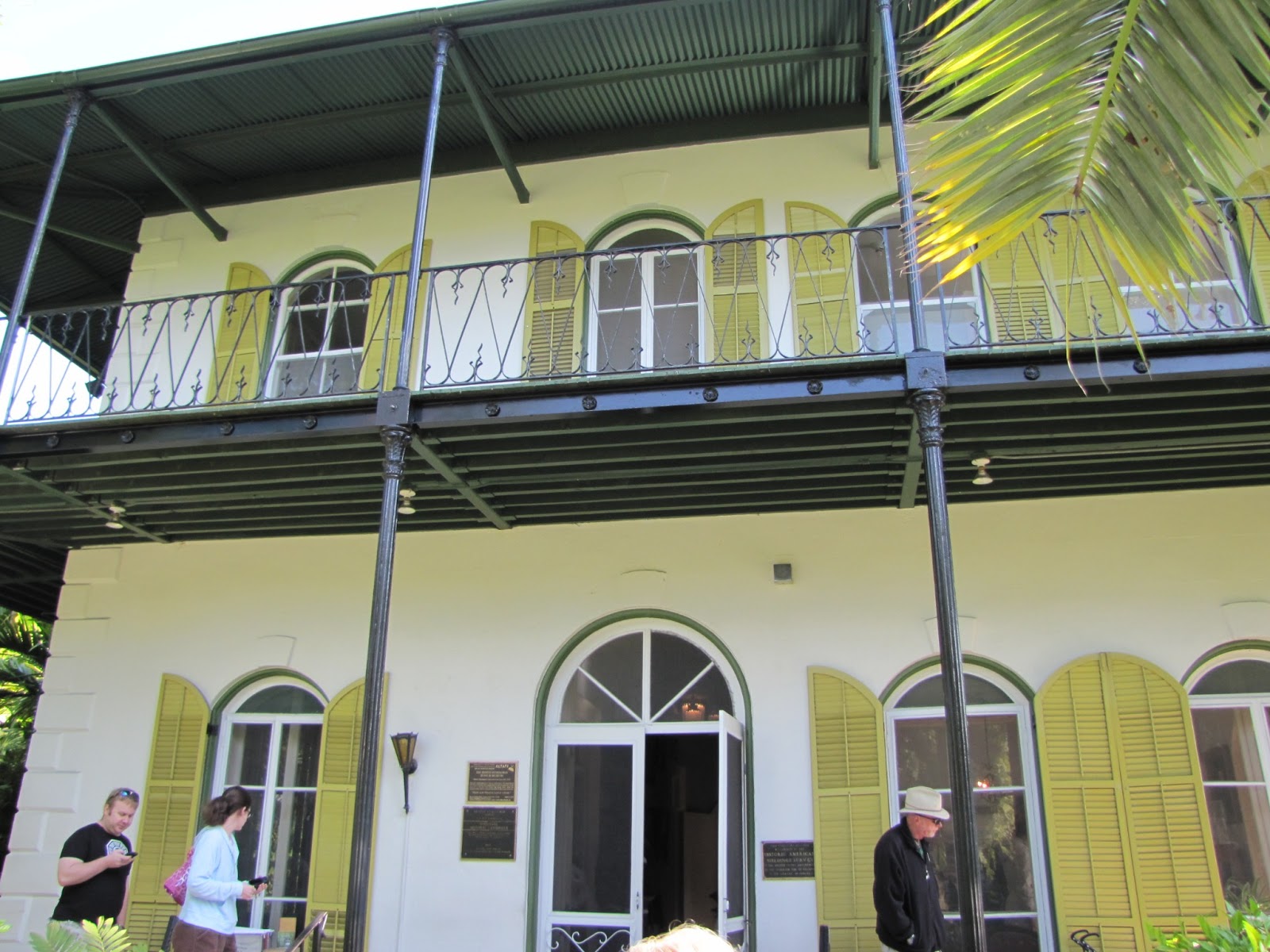
1.  The Hemingway House
     
The Hemingway House on Whitehead Street

Ernest Hemingway's work study on the second floor


A descendant of one of Hemingway's six-toed cats

Hemingway's Study

The urinal salvaged from the renovation of Sloppy Joe's bar by Hemingway and turned into
a water bowl for his cats.

The penny Hemingway threw on the ground when he realized his wife
Pauline had spent $20,000 to install an in-ground pool in the back yard.


2. Blue Heaven Restaurant


Great Key Lime Pie at Blue Heaven

Lunch or dinner companion


3. Colonial Hotel (Now Crowne Plaza - La Concha Hotel)

Lobby of the Crowne Plaza La Concha Hotel


4.St. Mary, Star of the Sea Catholic Church

St. Mary, Star of the Sea Catholic Church

Stations of the Cross Garden at St. Mary, Star of the Sea


5. 830 Fleming Street - formerly Electric Kitchen

Now an art gallery


6. Thompson's Docks (Key West Bight)

Memorial for Norberg Thompson


7. 314 Simonton Street (Casa Antigua - private residence) - formerly Trevor and Morris Apartments


8.  Captain Tony's - formerly The Blind Pig and the original Sloppy Joe's


9. Sloppy Joe's Bar
View from Duval Street

Duval and Green Street